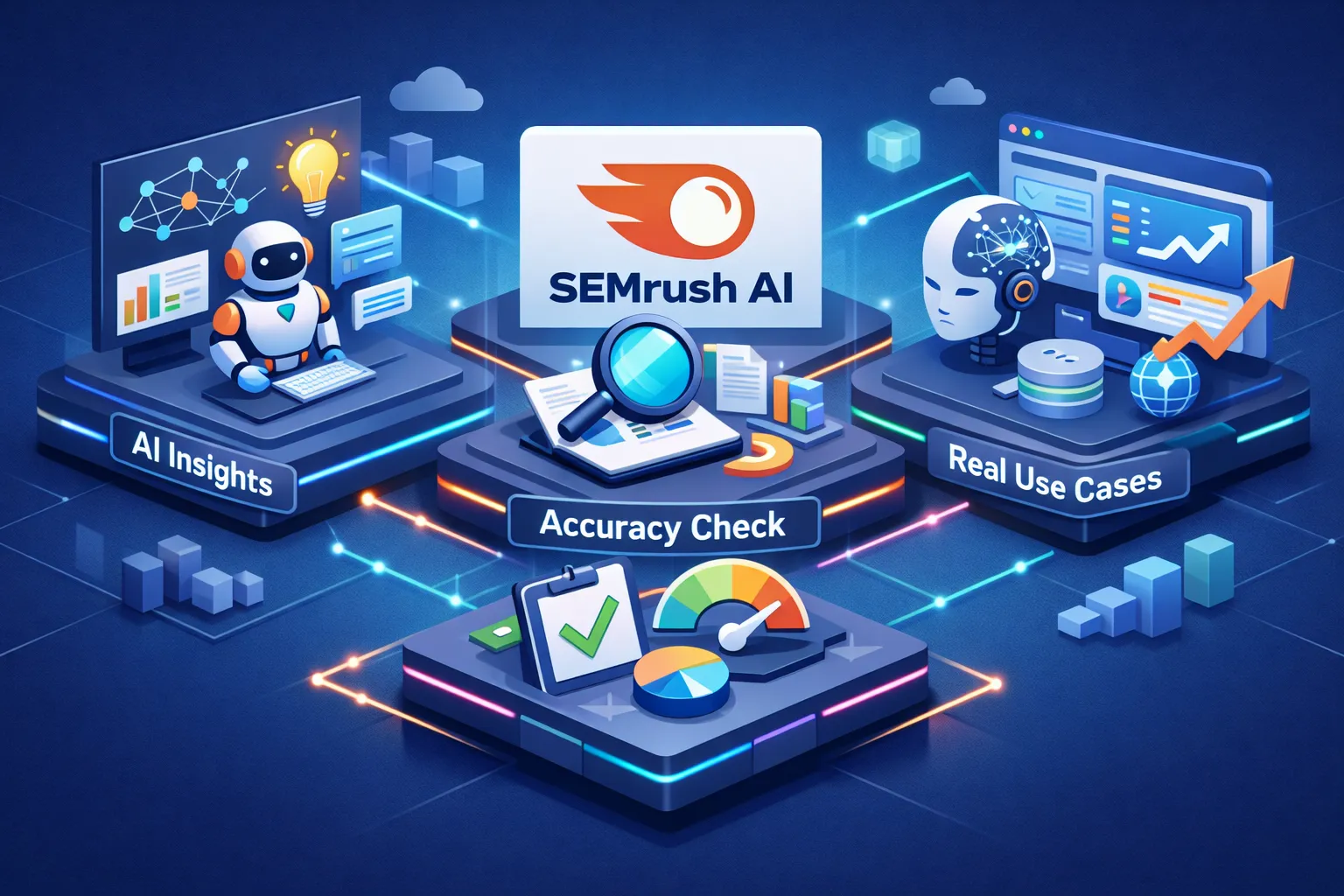
Semrush AI sounds like a major upgrade. The marketing is confident, the feature list is long, and the screenshots look impressive. But most affiliates running content campaigns have no clear idea which features actually move the needle, which numbers to trust, and which parts of the toolkit are directional signals versus hard data.
This article gives you a straight breakdown of what Semrush AI includes, how it calculates the metrics you’ll be reporting on, where the data gets shaky, and how to use it practically to audit and fix affiliate campaigns. At InternetMoneyPro, we’ve built a diagnostic mindset into every step of our affiliate system, and the platform fits neatly into that framework when you know exactly what it measures and what it doesn’t.
If you’re running affiliate campaigns in 2025 and ignoring your AI search visibility, you’re likely competing blind against marketers who aren’t. Industry data and Semrush’s own research suggest that AI-generated answers are increasingly intercepting buyer-intent searches before users reach organic content. That shift is the real stakes here.
What Semrush AI actually includes
The first confusion point for most users is treating “Semrush AI” as a single feature. It’s not. There are at least two distinct toolkits, and conflating them leads to misreading what the data is telling you.
The AI Toolkit is built around brand monitoring and competitive intelligence inside AI environments. It includes Business Landscape reports (AI market share and visibility by category), Brand and Marketing reports (sentiment analysis), Audience and Content reports (query themes), AI-generated recommendations, and competitor analysis for up to 50 brands. The job of this toolkit is diagnostic: it shows you where your brand or the offer you’re promoting stands in AI-generated conversations.
The AI Visibility Toolkit is different. It focuses on tracking SEO performance specifically in AI-generated search results. Its components include Visibility Overview, Prompt Research (with AI Topic Volume, intent, topic difficulty, competing brands, and related topics), Brand Performance with Share of Voice and sentiment tracking, Position Tracking with three-month projections, the Keyword Strategy Builder, and the AI Search Site Audit. This toolkit is more predictive and action-oriented.
One important caveat on access: these tools are bundled in Semrush One plans, not the standard Pro, Guru, or Business SEO subscriptions. Semrush One Starter begins at $199.95 per month. Standard plan subscribers can add the AI Visibility Toolkit for approximately $99 per month, though the billing model, per user or per domain, varies by plan. Because Semrush’s plan structure has been evolving, verify the exact inclusions on their pricing and plans before you commit.
Using Semrush AI Writer for affiliate content
Semrush AI Writer is a separate but connected part of the ecosystem. It offers a library of content templates, multilingual support across 30-plus languages, and pulls from Semrush’s competitive SEO data rather than generating content in isolation. That last part is its real differentiator as an AI content generator: the output is grounded in keyword and competitive data, not just a generic language model response.
Two things affiliates should know upfront: there’s no built-in plagiarism checker, and there are no explicit factuality controls. The tool grounds content in Semrush’s SEO data, which limits some hallucination risk, but it doesn’t verify facts independently. For affiliate content where accuracy affects trust and conversions, that gap matters.
How the integrated dashboard works
Semrush One consolidates these toolkits into a single dashboard. For affiliates managing multiple campaigns across different niches or offers, this matters more than it might seem. Instead of jumping between separate reports for prompt data, competitor metrics, and visibility scores, everything feeds into one view. The consolidation reduces friction in the audit workflow, which we’ll cover in detail below.
How Semrush calculates AI Visibility and what the score actually means
The AI Visibility score is a proprietary 0, 100 metric. The score aggregates three raw inputs: Monthly Audience (the volume of topics that mention a brand), Mentions (the count of AI answers that feature the brand), and Cited Pages (the specific domain pages that LLMs actually source when generating answers). These three components combine into a visibility score relative to Semrush’s benchmark sample. Understanding what it actually measures prevents you from over-interpreting the number in either direction.
A score of 40 does not mean you’re visible to 40% of AI users. According to Semrush’s own documentation on its Prompt Database, it means you score 40 relative to a curated dataset of 2,500-plus prompts. The data source is Semrush’s own Prompt Database, not a neutral third-party crawl of LLM outputs. You’re benchmarking against a sample, not the full universe of AI-generated search responses.
AI Share of Voice explained: why it matters for affiliate campaigns
AI Share of Voice is calculated by dividing a brand’s mentions by total mentions across all analyzed brands. Semrush uses 10% as the low watermark: below that, a brand needs content and structural improvements to appear in AI-generated answers. Above 15% signals strong positioning in that AI search environment.
For affiliates, this number has a direct revenue implication. If the offer you’re promoting has a low AI Share of Voice in its category, your content is likely not surfacing in AI-generated answers to buyer-intent queries, and those are exactly the searches that convert. A weak score is a signal to audit the content and structure behind your campaign, not just a vanity metric to monitor.
Where Semrush AI data gets unreliable
The toolkit is a directional tool. It identifies trends, surfaces opportunities, and flags competitive gaps. It is not a source of ground truth for precise traffic or citation data, and treating it as one will lead to bad decisions.
Semrush traffic estimates frequently run 2, 10 times higher than actual Google Search Console data. Keyword detection rates also fall behind Ahrefs for smaller or niche sites. Cross-referencing with GSC for traffic validation is non-negotiable if precision matters to your campaign decisions.
The accuracy of Semrush AI Visibility scores carries its own set of limitations. No independent benchmark study has yet compared these scores against actual measured citation frequency in ChatGPT or Google AI Overviews. The correlation between the score and real-world AI citation counts remains unverified outside Semrush’s own research. Treat the score as a directional signal, not a confirmed audit trail.
User-reported bugs and the paraphrasing problem
There are known issues worth factoring into how you interpret the data. One analysis of Semrush’s AI-generated outputs, referenced in Semrush’s own research materials, reports a similarity score of only 0.53, 0.54 between AI responses and their original source content, with alignment between AI outputs and actual user prompts sitting at just 0.04, 0.05. Those are low numbers. In practice, the tool blends and paraphrases from multiple sources rather than citing them precisely.
For affiliates using AI-cited content as a quality benchmark, this matters. A page that gets surfaced as a cited source may not actually be the best-answer content in that space. The AI is synthesizing, not quoting, and the engagement signals on cited posts are often weaker than you’d expect: posts with fewer than 20 upvotes frequently get surfaced over higher-performing alternatives. Use the citation data as directional input, not a quality endorsement.
How to audit your affiliate campaigns with Semrush AI
The practical value of these AI SEO tools for affiliates comes from a three-step workflow: find where you’re invisible, understand why, then fix it. Each part of the AI Visibility Toolkit handles one step of that process.
The AI Search Site Audit handles step one. It checks whether major AI crawlers, ChatGPT-User, OAI-Searchbot, Google-Extended, Perplexity bots, and others, can access your site. It flags missing llms.txt files, weak internal linking, non-descriptive anchor text, broken links, duplicate content, and structural issues that reduce how well LLMs can parse and retrieve your content. For affiliates, the most actionable output is the list of pages that could rank in AI answers but currently don’t, paired with specific recommendations to fix them.
Using Prompt Research to find content gaps
Prompt Research is where the competitive intelligence becomes actionable. You filter by “Missing” topics: prompts where competitors are being mentioned in AI-generated answers but your content isn’t. The tool surfaces AI Topic Volume, intent, topic difficulty, competing brands, and related topics for each gap.
For an affiliate in personal finance, software tools, or health products, this reveals exactly which sub-topics competitors are winning in AI-generated answers. That’s faster and more targeted than traditional keyword gap analysis because it shows where AI answers are already being served to buyers, not just where organic traffic exists.
Brand Performance tracking for affiliate offers
The Brand Performance suite tracks sentiment, narratives, and recommendations around a specific brand or product. For affiliates, this is more than a monitoring tool. If the offer you’re promoting is generating negative AI sentiment patterns, that can suppress conversions even when your SEO traffic looks healthy. A content strategy that doesn’t account for negative brand narratives in AI search environments is leaving a hole in the funnel.
Turning Semrush AI insights into real SEO fixes
Data without action is just overhead. Once the audit identifies gaps, the workflow moves to content creation and campaign restructuring.
The connection between Prompt Research and AI Writer is the platform’s practical strength here. Take the gaps identified in Prompt Research, feed the topic and intent signals into AI Writer’s template system, and produce content structured around the factors LLMs cite: clear headings, semantic HTML, entity clarity, and E-E-A-T signals. The Keyword Strategy Builder then clusters these topics into a campaign structure rather than leaving you with a disconnected list of individual content pieces.
Many users who adopt these tools stop at the reporting stage, they have the data but no system for acting on it. The result is dashboard screenshots that don’t change anything downstream. You don’t need to become an SEO analyst to use Semrush AI effectively, but you do need a repeatable process that turns findings into campaign fixes.
When Semrush AI is actually worth the cost
The pricing is significant. Semrush One Starter runs $199.95 per month, and access to the full AI Visibility Toolkit as a standalone add-on starts at approximately $99 per month on top of a base plan. That’s a real cost to justify, and the honest answer is that it’s not justified for every affiliate.
The tool earns its cost when you’re managing multiple content campaigns simultaneously, tracking AI search visibility across several competitors, or running campaigns for a brand with meaningful AI Share of Voice to protect or grow. At that scale, the competitive intelligence and audit capabilities compound across campaigns in ways that make the price defensible.
Who gets real value from Semrush AI features
The affiliate who benefits most is intermediate to advanced: already generating some traffic, running content-heavy campaigns, and needing structured competitive intelligence in AI search environments. If you’re managing a portfolio of affiliate sites or scaling a single authority site, the toolkit gives you a real signal layer that would otherwise require manually monitoring multiple AI platforms.
Who should start somewhere simpler
Why Affiliate Marketing Isn’t Working for You (And the Real Fix) running a single-offer campaign with no existing content base don’t need this yet. Paying for a tool you can’t act on is worse than not having the data. A focused system paired with free or lower-cost AI SEO tools covers the same essential ground with far less complexity. Build the foundation first, then add the signal layer when you have campaigns worth analyzing.
The bottom line on Semrush AI
Semrush AI gives affiliates a real lens into AI search performance, with a clear caveat: it’s a directional tool, not a ground-truth oracle. The AI Search Site Audit and Prompt Research are where the practical value sits. Use them to find where your campaigns are invisible in AI-generated answers, use AI Writer to close the content gaps, and cross-reference with Google Search Console for any traffic numbers that matter to your decisions.
The tool is only as good as the process behind it. If you’re at the stage where you need a system that makes Semrush AI data actionable without requiring expert-level interpretation, The Blog | Real Answers for Real Affiliate Marketers‘s diagnostic affiliate framework was built exactly for that: identify the broken component, apply a targeted fix, measure the output. That’s the loop that turns AI visibility data into affiliate revenue.
Leave a Reply