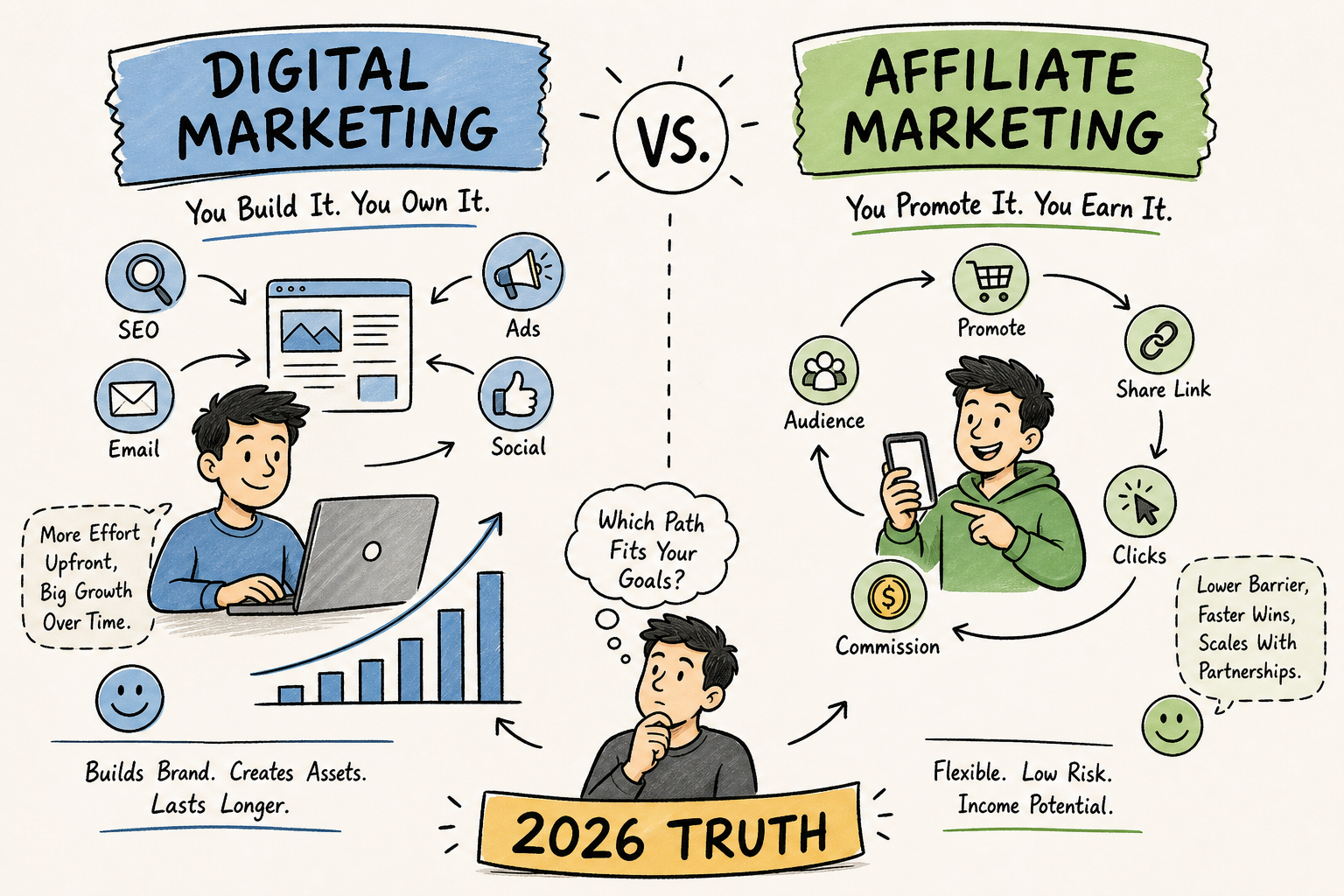
Most people use “digital marketing” and “affiliate marketing” as if they mean the same thing. That confusion isn’t just semantic, it leads to wasted budgets, wrong strategies, and months spent on tactics that were never going to work for the goal at hand. The two concepts are related, but they aren’t interchangeable, and treating them as equals is one of the most common early mistakes we see at InternetMoneyPro.
Here’s the short version: understanding digital marketing and affiliate marketing as distinct but connected disciplines is what separates people who get results from people who spin their wheels. Digital marketing is the full picture. Affiliate marketing is one specific model within it, defined by how payment works rather than where the promotion happens.
By the end of this article, you’ll have a clear definition of both, a realistic look at costs and risk, a breakdown of which model fits which situation, and a straight read on how 2026 is reshaping the way both operate. No padding. Just what you actually need to decide which path to take.
What digital marketing actually covers
Digital marketing is the full set of tools businesses use to reach customers online. That includes search engine optimization, paid search, social media, email, display advertising, and video. These channels don’t operate in isolation. A Google Ad drives someone to a landing page; email follows up; retargeting ads bring them back. The entire pipeline is connected, and a business running direct digital campaigns controls every stage of it. For a practical primer on the fundamentals behind these channels, see this overview of digital marketing basics.
That control has a cost. When you run in-house digital campaigns, you pay for every stage of the funnel whether it converts or not. SEO for a small business typically runs $1,500 to $5,000 per month. A modest Google Ads budget lands between $2,000 and $10,000 per month. Content marketing adds another $2,000 to $8,000 on top of that. And those are small-business figures. B2B software companies average $5,000 to $50,000 per month on Google Ads alone.
The key characteristic of direct digital marketing isn’t the channel. It’s the payment structure. You spend upfront. You optimize afterward. The results are not guaranteed, and the financial risk sits entirely with you.
Where digital marketing and affiliate marketing diverge
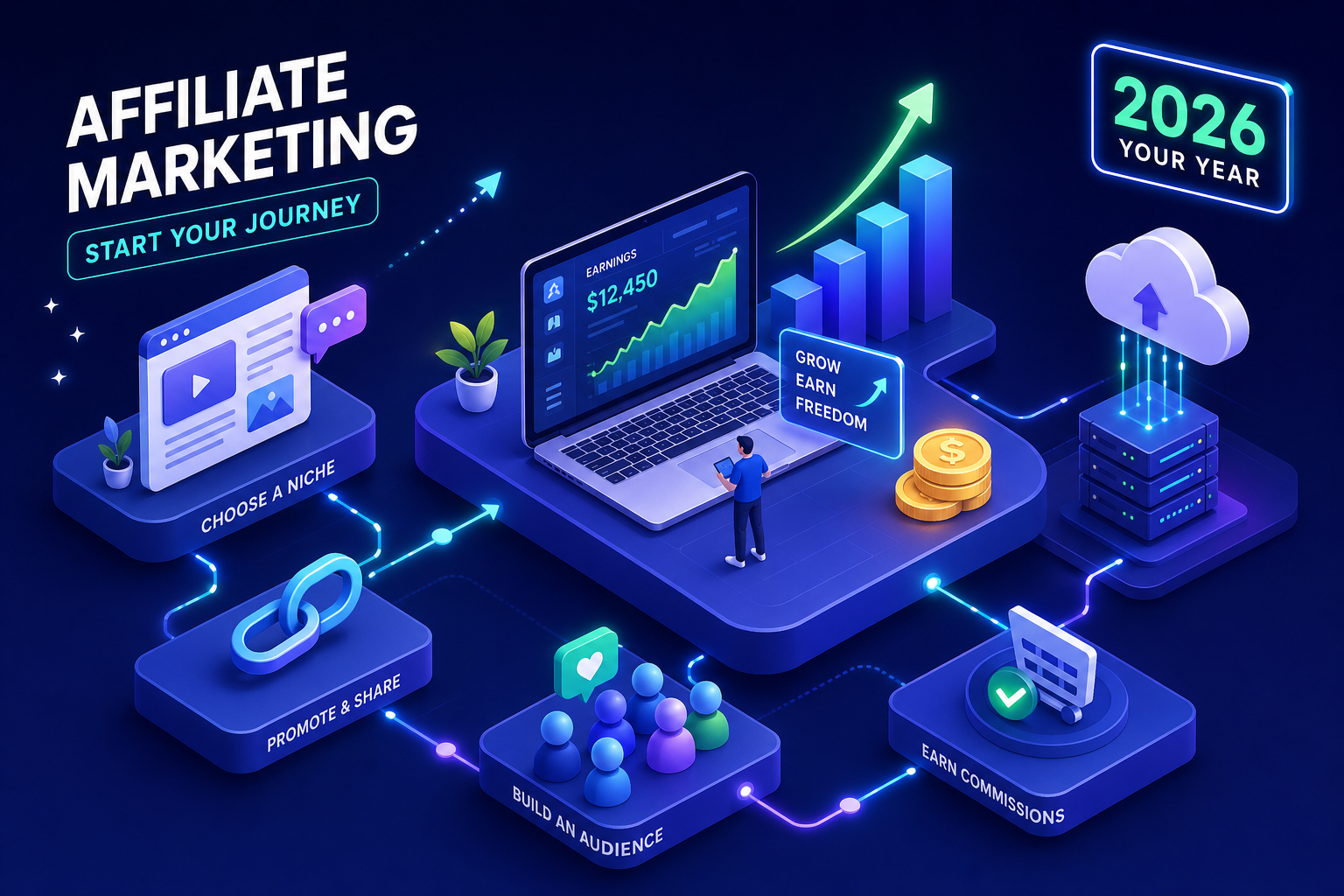
Affiliate marketing lives inside digital marketing as a specific performance-based model that operates across multiple digital channels, distinguished by one thing: how money changes hands. Instead of paying upfront for clicks or impressions, a merchant pays affiliates only when a defined action occurs, typically a sale, a lead, or a broader acquisition event. If you want a clear, concise explanation of how affiliate marketing works at a conceptual level, this affiliate marketing guide is a solid reference.
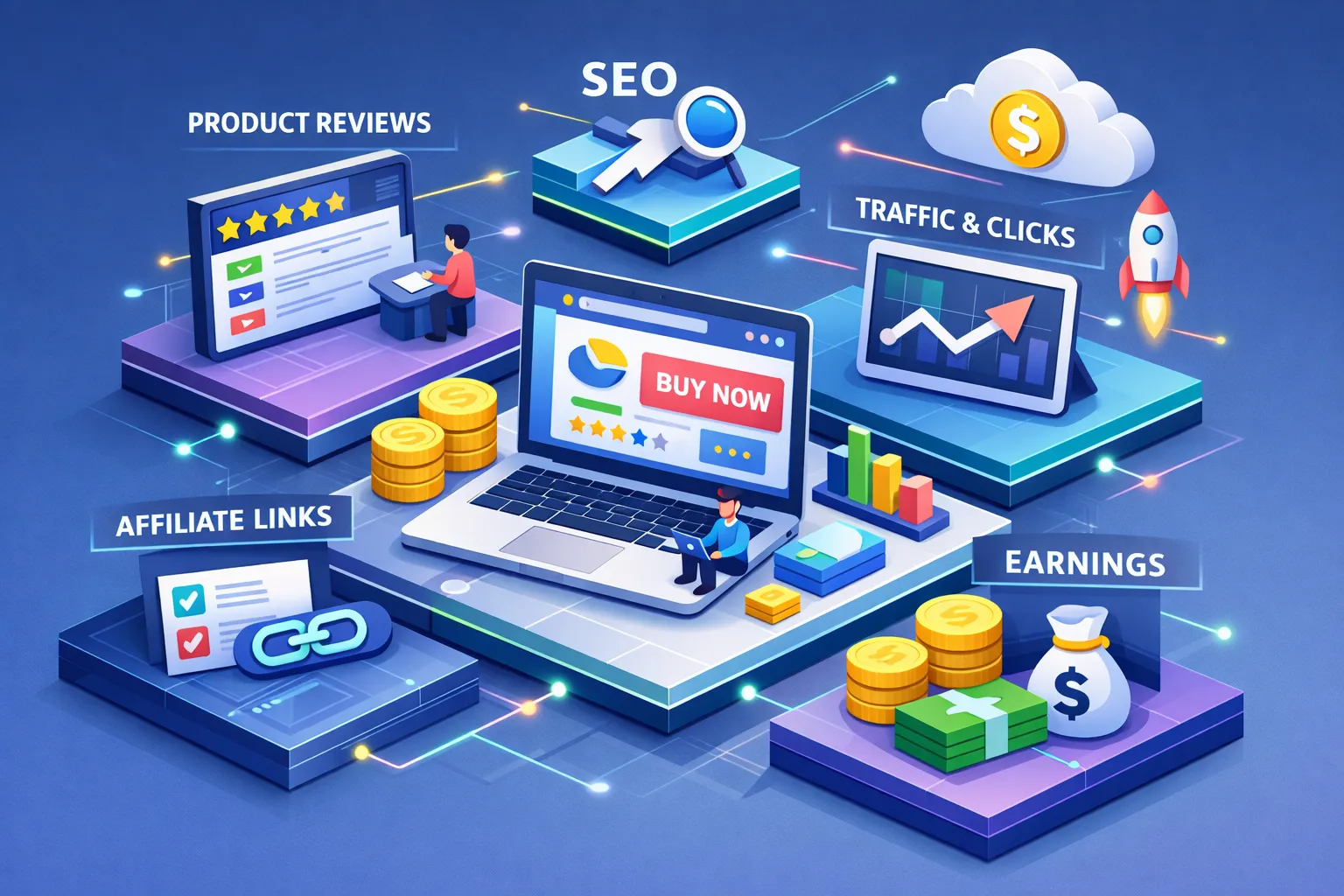
The structure involves four parties: the merchant who creates the product, the affiliate who promotes it, an optional network that connects them and handles tracking, and the customer who takes the action. The affiliate shares a unique tracking link through their blog, email list, YouTube channel, or paid ads. When a customer clicks and converts within the cookie window, the affiliate earns a commission.
Commission models vary depending on what the merchant values. Pay-per-sale gives the affiliate a percentage of each transaction, typically 5% to 30%. Pay-per-lead pays a flat fee for every qualified signup or inquiry. CPA (cost-per-acquisition) covers any defined action. Recurring commissions, common in SaaS, pay the affiliate a percentage every month the customer stays subscribed. A SaaS tool that pays 30% recurring on a $100/month subscription creates compounding income for affiliates who build an audience once and collect commissions indefinitely.
It’s also worth distinguishing affiliate marketing from referral marketing. Referral programs typically reward existing customers for bringing in new ones, usually with a one-time credit or discount. Affiliate marketing is a structured commercial arrangement with publishers, creators, or marketers who promote in exchange for performance-based commissions. The two models overlap in concept but differ in execution and scale.
Costs, risks, and real ROI: digital marketing vs. affiliate marketing
Upfront ad spend vs. CPA
Direct digital campaigns carry the full financial risk. A PPC campaign can burn $5,000 in 30 days and return nothing if the targeting is off or the landing page doesn’t convert. There is no performance guarantee. Businesses with experienced teams and testing budgets can absorb that risk. Beginners and lean operators often can’t, and the data reflects how steep these costs get: legal services companies average $10,000 to $100,000 per month on Google Ads, and even e-commerce businesses at the small-to-mid level spend $2,000 to $25,000 monthly.
Affiliate marketing fundamentally shifts that risk equation. The merchant pays only on confirmed results. Commission rates run 5% to 30% of sale value depending on the product and margin. Well-run affiliate programs deliver $6.50 to $15 for every dollar spent, with established programs reaching $16:1 in some cases.
Merchant vs. affiliate risk
For the affiliate, the risk is time and effort invested in content, promotion, and audience-building with no guaranteed return. For the merchant, the risk of a failed campaign disappears because payment is tied to results rather than activity. The trade-off is clear: merchants get lower financial exposure, while affiliates accept execution risk in exchange for scalable income potential. Neither model is categorically better. They serve different positions in the risk-reward spectrum, and understanding that difference is what lets you make the right call for your situation.
Which business models actually win with each approach
Affiliate marketing has a documented track record with high-margin, recurring-revenue products. SaaS tools, digital courses, and niche physical goods consistently perform well because the commission economics make sense for affiliates. Shopify pays up to $2,000 per referral. Semrush runs a hybrid model combining $200 per sale with $10 per trial. These programs work because the customer lifetime value is high enough to absorb a meaningful affiliate commission and still leave the merchant with a healthy margin. Wirecutter built an entire media business on this model.
In 2026, AI tools and automation software have become the fastest-growing affiliate category. HubSpot’s affiliate program pays 30% recurring for up to a year. Education platforms like Coursera offer commissions up to 45%. The pattern is consistent: products with long subscriber retention and high ticket value create the best affiliate economics.
In-house digital marketing outperforms affiliate channels in specific situations. Branded e-commerce, local services, and products requiring tight brand control are better served by direct campaigns. Private-label products need consistent messaging that a network of independent affiliates can’t reliably deliver. Businesses where customer data and retargeting pipelines are core assets should own their marketing channels. The rule of thumb is straightforward: if brand equity and the customer relationship are the primary asset, keep marketing in-house and invest in owning the funnel.
How 2026 shifts are rewriting the affiliate playbook
The affiliate environment in 2026 looks materially different from even two years ago. Cookie deprecation has forced programs to move toward server-to-server tracking, first-party data collection, and unique promo codes. The old reliance on third-party browser cookies is gone for most serious programs. Affiliates who haven’t updated their tracking setup are losing attribution they’ve earned. For practical options on moving beyond cookies, read about cookieless tracking solutions.
AI tools are the other major shift. Affiliates using AI for content creation, audience segmentation, and conversion optimization are producing 30 to 50 pieces of content in the time it previously took to write one. AI-driven personalization generates 2 to 5 times higher click-through rates compared to static product lists. Predictive audience segmentation delivers 3 to 5 times higher conversion rates than traditional manual approaches. These are not marginal improvements. They’re structural advantages for affiliates who adopt these tools early. For a closer look at the evolving AI impact on affiliate marketing, that analysis is worth reviewing. If you’re ready to operationalize those benefits, our guide on how to use AI for affiliate marketing walks through a practical daily workflow.
Commission structures are also evolving. Programs are moving toward tiered models that reward top performers with higher rates. Live commerce integrations on TikTok and Instagram now demand real-time tracking, while direct brand-to-affiliate partnerships are replacing impersonal network transactions. Brands are working more closely with affiliates as strategic partners rather than anonymous traffic sources. At InternetMoneyPro, our annual affiliate trend webinar breaks down exactly which niches are gaining traction, what commission models are rewarding affiliates most in the current environment, and where the next wave of performance-based opportunity is forming, practitioners use it to track which niches and commission models are actually paying out.
A practical first-step checklist for choosing your path
The choice between affiliate marketing and direct digital marketing isn’t a philosophical one. It comes down to four concrete questions. Answer them honestly and the right path becomes clear.
- Do you have ad budget or time? Direct digital campaigns require upfront spend. Affiliate marketing requires content creation and promotion effort. If you have budget and a team, in-house campaigns are viable. If you have time but limited capital, affiliate marketing fits better.
- Do you own a product or want to promote someone else’s? Merchants with their own offers should evaluate whether an affiliate program makes sense as a distribution channel. If you don’t have a product, affiliate marketing is the clear path, you promote what already exists and earn on results.
- Do you need brand control? If consistent brand messaging is non-negotiable, run your own campaigns and maintain full oversight of every touchpoint. If you’re comfortable with performance-based promotion across independent publishers, affiliate marketing scales faster with far less operational overhead.
- What’s your risk tolerance? Direct campaigns front-load the financial risk, you spend before you know if it works. Affiliate marketing shifts execution risk to the affiliate side. Choose based on what you can actually absorb right now, not what you hope to absorb later.
For those who land on affiliate marketing as the right fit, the next question is how to execute without guesswork. That’s exactly what the system at InternetMoneyPro is built to answer, a step-by-step process focused on one offer, one clearly defined audience, and a repeatable structure that removes the random-tactics problem most beginners run into. If you want a structured starting point rather than reverse-engineering everything alone, that’s where to go next.
The bottom line on digital marketing and affiliate marketing
Digital marketing is the full picture. Affiliate marketing is one high-leverage channel within it, defined by its performance-based payment structure and its ability to scale without upfront ad spend. They’re not competing strategies, they’re different levels of the same map.
In 2026, the two are converging. AI tools, server-side tracking, and first-party data strategies that once lived in enterprise marketing departments are now directly available to solo affiliate marketers. The gap between what a well-equipped affiliate can execute and what a funded in-house team can produce has narrowed significantly, a shift that’s opened real opportunities for independent operators who know how to use these tools.
The right question isn’t which model is better in the abstract. It’s which fits your current resources, risk tolerance, and goals. When you understand digital marketing and affiliate marketing for what they actually are, distinct tools with distinct economics, the answer usually becomes obvious. If it points toward affiliate marketing and you want a proven path rather than a long trial-and-error process, InternetMoneyPro exists precisely for that.