Many affiliate ad campaigns don’t fail because the offer is bad. They fail because no one caught the failing creative in time, and without the right AI advertising tools in place, that window closes fast. Budgets bleed quietly while click-through rates slide and cost-per-acquisition climbs. By the time a human notices, hundreds or thousands of dollars have already been served to the wrong signal, depending on your spend level.
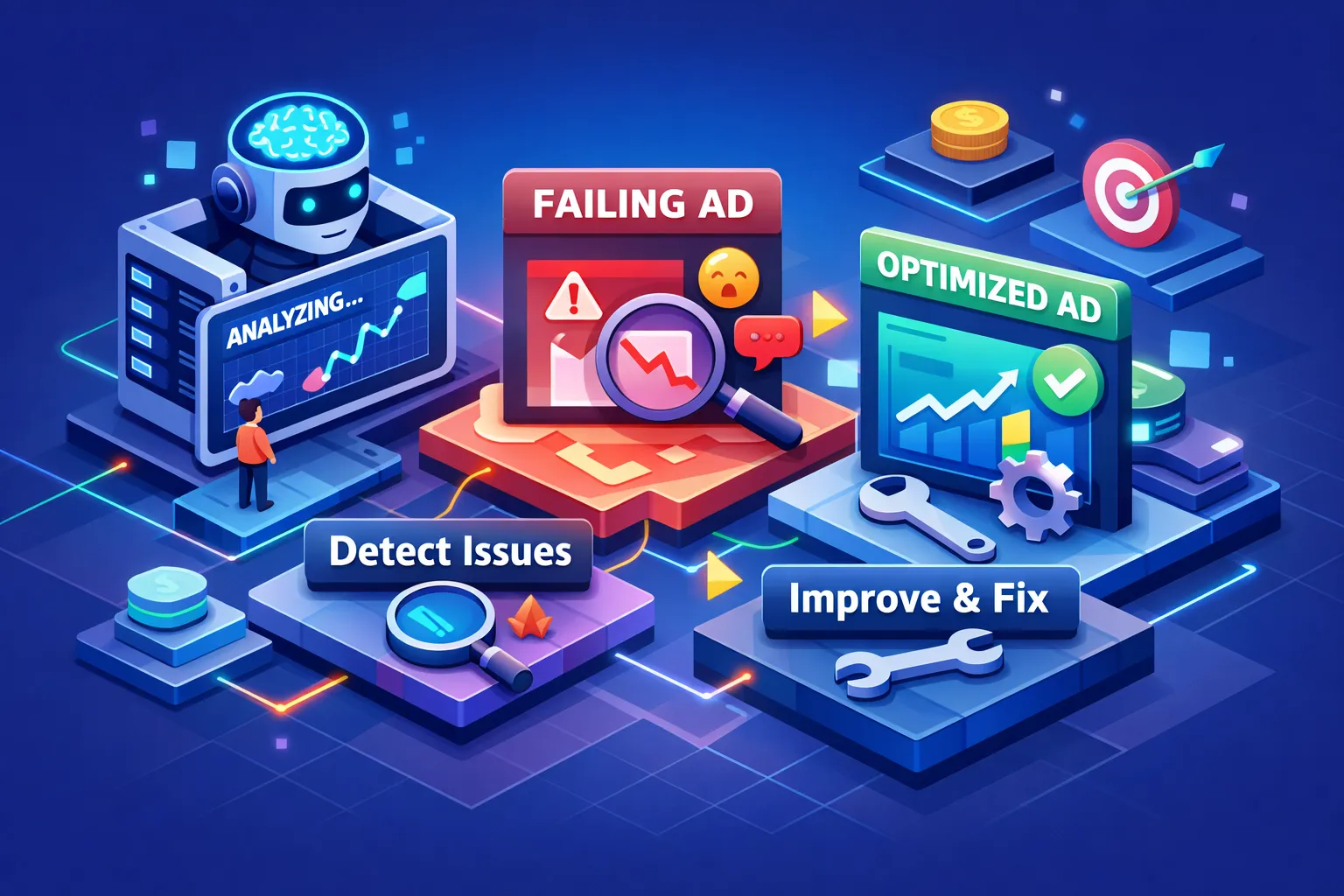
AI advertising tools change this dynamic by doing what manual management can’t: scoring, flagging, and swapping underperforming creatives in real time, without waiting for a weekly report or a gut feeling. This isn’t a feature dump of fifteen platforms. This is a focused guide to how these tools work diagnostically, which ones fit which use case, and how to implement one with a clear measurement plan from day one.
Affiliates in particular need this edge. You’re running paid traffic to someone else’s offer, which means every wasted impression costs you margin you can’t recover on the back end. The tools covered here address that problem directly.
Why ad creatives bleed your budget before you notice
Many advertisers check campaign performance weekly, or only when something looks obviously wrong. By then, a creative has already served thousands of impressions at a poor CTR or an inflated CPA. The gap between when a creative starts underperforming and when a human notices it is exactly where money disappears.
Consider a common affiliate scenario: you’re running a single static creative to cold traffic on Meta, and the algorithm is optimizing toward link clicks rather than purchases. The CTR looks acceptable on the surface, but your CPA is climbing every day. Nothing in your dashboard flags it as a crisis. A week later, you’ve burned through your testing budget on the wrong signal.
The signals your data is already sending
There are four specific signals that indicate a creative is failing: declining CTR, rising CPA relative to your baseline, frequency creep without a corresponding engagement lift, and low thumb-stop rates on video. These aren’t abstract metrics reserved for media buyers with analytics teams. They’re the exact inputs that AI ad tools use to make automated decisions.
Declining CTR means your audience has seen the creative enough times to stop responding. Rising CPA means you’re paying more for each conversion while the creative loses relevance. Frequency creep above 3.5, a commonly cited benchmark, though the threshold can range from 2.5 to 4.0 depending on platform and audience, is a reliable sign of ad fatigue when conversions aren’t keeping pace. A weak thumb-stop rate on video tells you the first three seconds aren’t earning attention. Each of these signals appears in your data before performance fully collapses.
Why manual campaign reviews miss the window
Automated ad optimization tools flag underperforming creatives within 48 to 72 hours of accumulating sufficient data, sometimes faster when CTR drops 15 to 20% below a 7-day average. Manual reviews don’t operate on that timeline. By the time a weekly report surfaces a weak creative, the ad spend is already gone.
Manual audits also tend to focus on campaigns as a whole, not individual creative variations. Most affiliates don’t have the infrastructure to monitor 10 to 20 creative variants daily across Meta, Google, and TikTok simultaneously. That’s the case for automation. Not convenience, margin.
How AI advertising tools catch and fix underperforming creatives in real time
AI ad tools work differently from manual campaign management in one fundamental way: they ingest performance data continuously, not periodically. Each creative gets scored against a rolling baseline, and when performance dips below a defined threshold, the tool either flags it for human review or triggers an automated swap. The shift from rule-based bidding to predictive creative scoring is what separates these platforms from a simple alert system.
Automated creative scoring: what replaces the gut check
AdCreative.ai uses historical performance data to assign a score to each creative before it even goes live. This predictive scoring prioritizes which variations to serve first based on likely performance, not aesthetics or personal preference. The platform claims over 90% accuracy in performance prediction, treat that as a vendor figure worth testing against your own results, not a guarantee, which means the likely winning variation gets served first while weaker alternatives are tested at lower spend levels.
For affiliates testing multiple creative angles on a single offer, this matters. You’re not waiting five days to find out which hook performs. The tool front-loads impressions toward the most probable winner and flags the others early.
Real-time optimization loops versus static A/B testing
Traditional A/B testing waits for statistical significance, which can take days or weeks depending on your traffic volume. Real-time AI optimization shifts budget toward better performers within hours. That distinction is what “real-time” actually means in the context of AI ad creative tools: not faster reporting, but faster budget allocation.
Albert.ai‘s autonomous campaign management illustrates this clearly. The platform pulls live ROAS data from Meta, Google, and TikTok simultaneously, then moves budget from the lower-performing channel to the higher one without manual input. In a published Harley-Davidson case study, Albert.ai generated a 2,930% increase in leads, a ceiling-performance example worth anchoring your expectations to, not a baseline guarantee.
Top AI advertising tools broken down by use case
The right tool depends on what you’re trying to do, not on what has the best marketing page. Here’s how the leading platforms map to specific affiliate use cases.
High-volume static and social ad creatives
AdCreative.ai is the go-to for affiliates who need to test multiple creative variations at scale. Starting at $29 per month, it generates static and video ad creatives from a URL or prompt, scores them against historical performance data, and includes a competitor analysis feature that shows what’s working in your niche. The URL-to-creative generation alone saves significant research time when you’re testing several angles on a single affiliate offer.
Video ad production for short-form and social placements
HeyGen handles avatar-based personalized video ads, starting at $29 per month, and works well for affiliates who want talking-head style creative without hiring a spokesperson. Lumen5 converts scripts or text into video ads and ranges from $29 to $199 per month depending on output volume and brand controls. Both tools are suited to TikTok, Instagram Reels, and YouTube pre-roll placements, where video frequently outperforms static creative on engagement metrics, particularly on short-form platforms where attention is scarce.
If your offer converts better through demonstration or explanation than through a static image, these tools give you production capability without a production budget. That’s the practical case for adding them to your creative stack.
Autonomous cross-channel optimization at scale
InternetMoneyPro is built for advertisers running multi-platform campaigns who want the AI to manage budget allocation, media buying, and creative testing without constant human input. Pricing is custom, typically 3 to 10% of ad spend, which makes this an agency or mid-to-large affiliate operator tool, not a beginner option. If you’re spending less than $10,000 per month across platforms, the overhead doesn’t justify the cost. Above that threshold, the 15 to 25% ROAS uplift cited in Albert.ai’s published client data represents a meaningful return, though results will vary by vertical and campaign structure.
Matching AI advertising tools and platforms to your budget and setup
The most common mistake is buying a tool built for an agency when you’re a solo affiliate, or staying on an entry-tier tool when your volume demands professional-level automation. Understanding what each pricing tier actually delivers prevents both errors.
Pricing tiers decoded: what you actually get at each level
Entry tier ($0 to $100 per month) gives you basic automation, template-based creative output, and access to one or two platforms. This is where you validate ROI before committing real budget. Professional tier ($100 to $500 per month) unlocks full AI creative generation, multi-platform integration, and meaningful output volume, typically 25 to 75 creative assets per month based on current vendor pricing guides. Enterprise tier ($500 and above) adds unlimited output, predictive analytics, and custom onboarding, structured for high-volume operations running across many campaigns simultaneously.
Watch for per-seat and per-creative pricing models at the professional tier. These can catch early users off guard if they assume a flat monthly fee covers unlimited generation. Read the fine print before you commit, especially if you’re testing aggressively.
Platform integrations that matter for affiliate campaigns
Meta, Google Ads, and TikTok are the three platforms most affiliates run on. Tools like Unified.to, Supermetrics, and Revealbot offer native API connections to all three, with Supermetrics extending to 500 additional data sources for unified reporting. HubSpot adds CRM integration for lead-based affiliate models, and Metricool connects ad performance to social scheduling in one view.
Integration depth matters most when you’re running multi-channel campaigns and need unified performance data without manually pulling reports from three different dashboards. If you’re on a single platform, basic integrations are sufficient. If you’re cross-channel, invest in a tool with proper API connections from the start.
Running a cross-channel diagnostic before you scale ad spend
Before you invest in any AI ad tool, you need to know which part of your funnel is actually broken. Scaling with AI on top of a broken creative strategy doesn’t fix the strategy. It automates failure faster, at higher volume, with a monthly subscription cost attached.
What a proper ad audit actually uncovers
A proper diagnostic maps each active creative to its platform, audience segment, and funnel stage, then measures CTR, CPA, and conversion rate per creative at each stage. Many affiliates who run this process discover the problem isn’t the ad itself. It’s the mismatch between the creative angle and the audience segment. The offer is fine. The creative is targeting the wrong awareness level, or the landing page doesn’t match the promise the ad makes.
Identifying that disconnect before committing more budget is the highest-leverage step you can take. It surfaces the actual problem, not the symptom.
Using a diagnostic framework to fix creatives first
This is where InternetMoneyPro fits the diagnostic step specifically. The platform’s diagnostic output is what makes the generative step productive rather than repetitive.
The sequence matters: run the diagnostic first, identify what’s broken, then use the right AI advertising tool to build the replacement creative. Skipping the diagnostic and going straight to a new tool means generating more of the same kind of creative that wasn’t working. InternetMoneyPro’s diagnostic output is what makes the generative step productive rather than repetitive.
How to trial and implement your chosen AI ad tool
Once you have diagnostic clarity and know which tools fit your use case, the implementation path is straightforward. The goal in the first two weeks is data collection, not profit.
Your first 30 days with an AI advertising tool
Start by using the cross-channel diagnostic to identify one underperforming creative. Generate three to five replacement variations with your chosen AI advertising tool, based on the diagnostic output. Set up a real-time monitoring rule or automated alert for CTR and CPA thresholds. Then let the tool optimize for the first two weeks before you review results, and resist the urge to intervene during that window. You need clean data, and interference corrupts it.
The metrics that tell you if it’s working
Define three benchmarks before you start. Target a 15 to 30% CTR lift versus your baseline creative. Target a 10 to 20% CPA reduction versus the previous creative. Track ROAS trend over 30 days rather than week-over-week fluctuations. Published benchmark data from a Proxima.ai case study shows Janessa Leoné’s campaign achieved a 73% CTR lift and 67% CPA drop with AI-driven optimization. That’s a realistic ceiling for what’s possible with a well-structured setup, not a guaranteed outcome, and it gives you a concrete reference point for evaluating your tool’s performance against real-world results.
The takeaway
AI advertising tools are not magic. They’re faster diagnostic and optimization systems. The affiliates who get results from them are the ones who understand what’s broken first, then use the right tool to fix it at scale.
The use-case matching is clear: AdCreative.ai for volume creative testing on static and social, HeyGen and Lumen5 for video placements where demonstration outperforms image, and Albert.ai for autonomous cross-channel management at higher spend levels. Pricing fit and integration depth matter more than brand recognition when you’re making this decision.
The best next step is not buying a tool. It’s running the diagnostic first. Start with InternetMoneyPro’s diagnostic framework to surface what’s actually broken in your current campaigns, then let your chosen AI advertising tool do its job on a foundation that’s already solid. Build the right base, and the tools work. Skip it, and you’re just spending faster on the same problem. Learn more about what an affiliate marketing system that works looks like.
Leave a Reply