
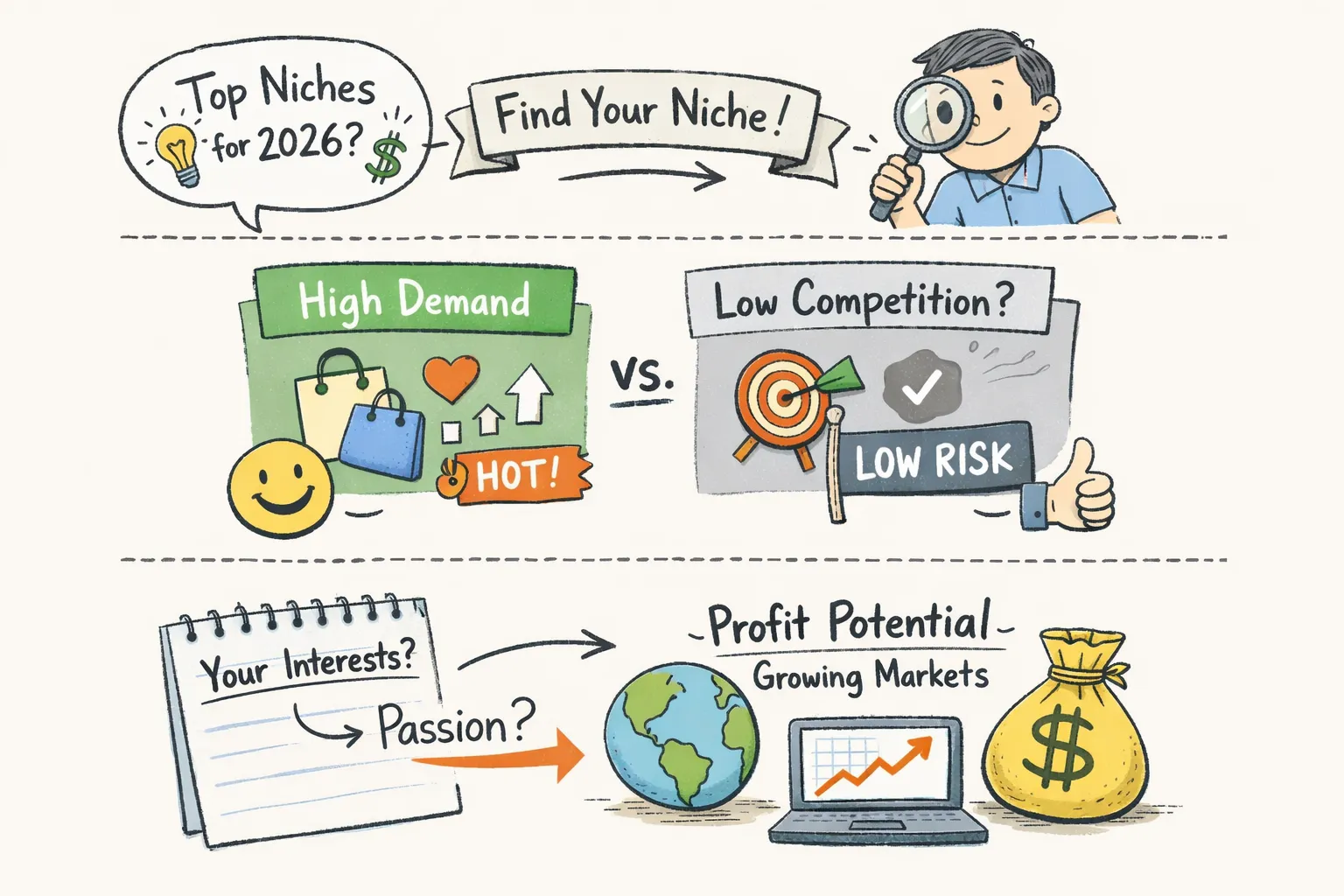
Picking an affiliate niche feels like the easy part. It’s where most people quietly set themselves up to fail. Someone watches a video about high-paying affiliate programs, picks personal finance because “the commissions are huge,” and spends three months building content that competes directly against sites with ten years of domain authority. Nothing converts. They blame affiliate marketing.
The problem wasn’t the niche. It was the selection process. Profitable affiliate niches aren’t chosen by gut feel or trend-chasing. They’re validated against demand, fit, and program quality before you write a single piece of content. This article covers which niches actually earn, where the low-competition pockets are, and how to confirm your pick before you write a word. At InternetMoneyPro, niche selection is the first diagnostic step in the entire affiliate system, because everything downstream, from your content to your conversions, depends on getting this right.
Why most people approach niche selection backwards
Most beginner affiliates start with “what’s popular” and work backwards to find an audience. That’s the wrong order. Profitability follows fit, not fame. A niche that’s hot without an audience you understand or content you can produce at volume is just noise dressed up as opportunity. If you’re stuck and want a practical fix for common mistakes, read Why Affiliate Marketing Isn’t Working for You (And the Real Fix) | InternetMoneyPro.
The gut-feel trap
The pattern repeats constantly. Someone picks personal finance because commissions are high, builds three articles, realizes they have nothing original to say, and quits. The flip side is equally useless: genuine passion for a niche with no audience demand means months of work with no one to read it. Both scenarios waste time you won’t get back.
The two variables that actually matter
Before you look at commission rates or competition scores, confirm two things: demand (people actively searching and spending money in this space) and fit (you can produce content here consistently without burning out). Everything else is secondary validation, including commission rates, which matter a lot but only after demand and fit are confirmed. This is exactly why we document What an Affiliate Marketing System That Works Actually Looks Like | InternetMoneyPro, it forces you to validate before you commit.
Affiliate niches with the strongest earning potential right now
The useful question isn’t which niches exist, it’s why certain categories outperform others. The best niches for affiliates in 2026 share two core traits: recurring revenue potential and high customer lifetime value, paired with audiences that research before they buy.
Recurring commission niches: SaaS and AI tools
SaaS and software subscriptions are the most structurally sound category for affiliate income. Standard commission rates run 20, 50% recurring monthly or annually. Systeme.io pays 60% recurring. Webflow pays 50% of first-year revenue. HubSpot offers 30% recurring for the first 12 months or a flat $1,000 per sale. The reason these numbers hold up is simple: once someone integrates a tool into their daily workflow, they rarely cancel. A single referred customer can generate affiliate income for years. High-paying affiliate niches in SaaS reward patience and a focused content strategy over raw traffic volume. For an outside perspective on the most lucrative categories, see this guide to the highest-paying affiliate niches.
High-ticket and fintech niches
Fintech and investment platforms pay flat fees of $50, $200 per funded account. eToro pays up to $200 per account. Empower pays up to $100 per qualified lead. One conversion here can outperform dozens of small product commissions from physical goods. Health, wellness, and digital education also belong in this tier, with 30, 70% commissions on course sales and strong demand trends through 2026.
Sleep aids, hair health products, and sauna gear are all showing 31, 65% year-over-year search growth (per Exploding Topics data). These reflect a structural shift in consumer spending, not a cycle, driven by sustained audience investment in personal wellness rather than seasonal spikes.
Platform fit by niche type
The niche you pick should match the platform where your audience gathers. SaaS converts best through blogs, email sequences, and YouTube tutorials where buyers research before committing. Wellness and beauty convert through Pinterest and short-form video, where visual content drives discovery and impulse-adjacent decisions. Fintech leans heavily on long-form SEO content because buyers want detailed comparisons before handing over financial information. Knowing this before you start saves you from building the wrong content format for your niche.
Low-competition affiliate niches worth entering in 2026
The main categories, finance, health, and SaaS, are competitive at the top level. Competing head-to-head with established authority sites on broad terms is a losing strategy for a new site. The opportunity sits one layer deeper, in the sub-niche layer where long-tail demand exists but fewer sites are specifically targeting it. These low-competition affiliate niches are where new publishers can gain real traction within months rather than years. See practical examples of low-competition blog niches to understand how narrow angles can win faster.
What a good affiliate sub-niche looks like
A worthwhile affiliate sub-niche has multi-word search terms with buyer intent, fewer than 20 strong competitors in the top 10 SERP results, and at least two affiliate programs that pay commissions worth the content investment. The goal isn’t zero competition. Zero competition usually means zero demand. You’re looking for manageable competition with a clear content angle that existing sites haven’t addressed well.
Subniches with measurable demand right now
Several niche ideas for affiliate marketing show strong long-tail signals with lower keyword difficulty than their parent categories. AI apps for anxiety and mood tracking sit at the crossover of mental health and AI tools, two independently growing markets, with search terms like “AI apps for anxiety tracking daily” generating real volume and minimal established competition. Apartment-friendly home gym setups (foldable equipment, quiet treadmills for noise-sensitive buildings) target a specific buyer with a specific problem that generic fitness content doesn’t solve.
Postpartum recovery products, beginner kombucha fermentation, and ethical AI compliance tools for small businesses each follow the same pattern: specific audience, specific problem, underserved search demand. New sites can rank for these within months rather than years because the competition is genuinely thinner.
How to match a niche to your actual skills
A niche with strong commission potential means nothing if you can’t produce content in it consistently for six to twelve months. This part requires honesty, not optimism.
Content format and skill alignment
Be direct with yourself about your actual format strengths. Are you a writer, a video creator, or a short-form content person? Health and beauty convert well on Pinterest and TikTok, which favor visual creators. SaaS converts through detailed written tutorials and YouTube comparisons, which favor writers and educators. Your content format should match your skills, and your skills should match the niche’s primary platform. Misaligning these is a common and avoidable mistake.
Audience clarity before content creation
Niche selection for affiliates only works when you can describe your reader in one clear sentence. “Wellness” is a topic category. “New moms recovering from diastasis recti looking for low-impact workouts” is an audience with a specific problem and buying intent. The narrower your audience definition, the more useful your content becomes, and the more trust you build before asking someone to click an affiliate link. Write that one sentence before you commit to any niche.
A simple checklist to validate your niche before you commit
Once you have a niche candidate, run it through three concrete steps. Each one has a clear action and a clear pass or fail signal. Skip any of these and you’re building on assumptions.
Step 1: Keyword demand check
Use Google Keyword Planner, SpyFu, or SE Ranking to confirm that high-intent keywords in your niche, specifically those with “best,” “review,” or “vs.” modifiers, have measurable monthly search volume. If the top keywords show fewer than 500 monthly searches and no commercial CPC, the demand isn’t there yet. A niche without search volume is a niche without buyers, regardless of how good the affiliate programs look on paper. For deeper reads on spotting high-intent keywords and how to weigh keyword volume vs difficulty vs search intent, review those guides when you do your research.
Step 2: Affiliate program audit
Confirm at least two to three affiliate programs exist in the niche with commissions worth building around. The benchmarks for high-paying affiliate niches are recurring commissions above 20% or flat fees above $50 per conversion. If the best program in your niche pays 4% on a $30 product, the math doesn’t support a serious content investment. This check takes thirty minutes and can save you months of misdirected effort.
Step 3: Content angle gap analysis
Search the top 10 results for your main target keyword and identify what’s missing: depth, a specific audience angle, updated information, or a format the existing content doesn’t use. If you can answer the question better, or for a narrower audience than the current top-ranking pages, you have a content gap worth targeting. Systematizing this step through a dedicated tool or a saved research template is what separates affiliates who move fast from those who stall on the starting line.
Choose your affiliate niche and validate it
The right affiliate niche isn’t the most famous one or the highest-paying one in the abstract. It’s the one where measurable demand exists, your content has a clear and defensible angle, and the affiliate programs pay commissions that justify the work. You don’t need to cover twelve niches or hedge your bets across three topics. Pick one, validate it properly, and build.
The checklist above is the bridge from research to action. Take the niche you’re currently leaning toward, run it through all three steps this week, and either confirm it or cut it. If it passes, you have a clear starting point. If it fails, you’ve saved yourself months of wasted content. Indecision is the only guaranteed path to earning nothing from an affiliate niche. For ongoing guidance and frameworks, visit Affiliate Marketing That Actually Works | InternetMoneyPro.
Leave a Reply