
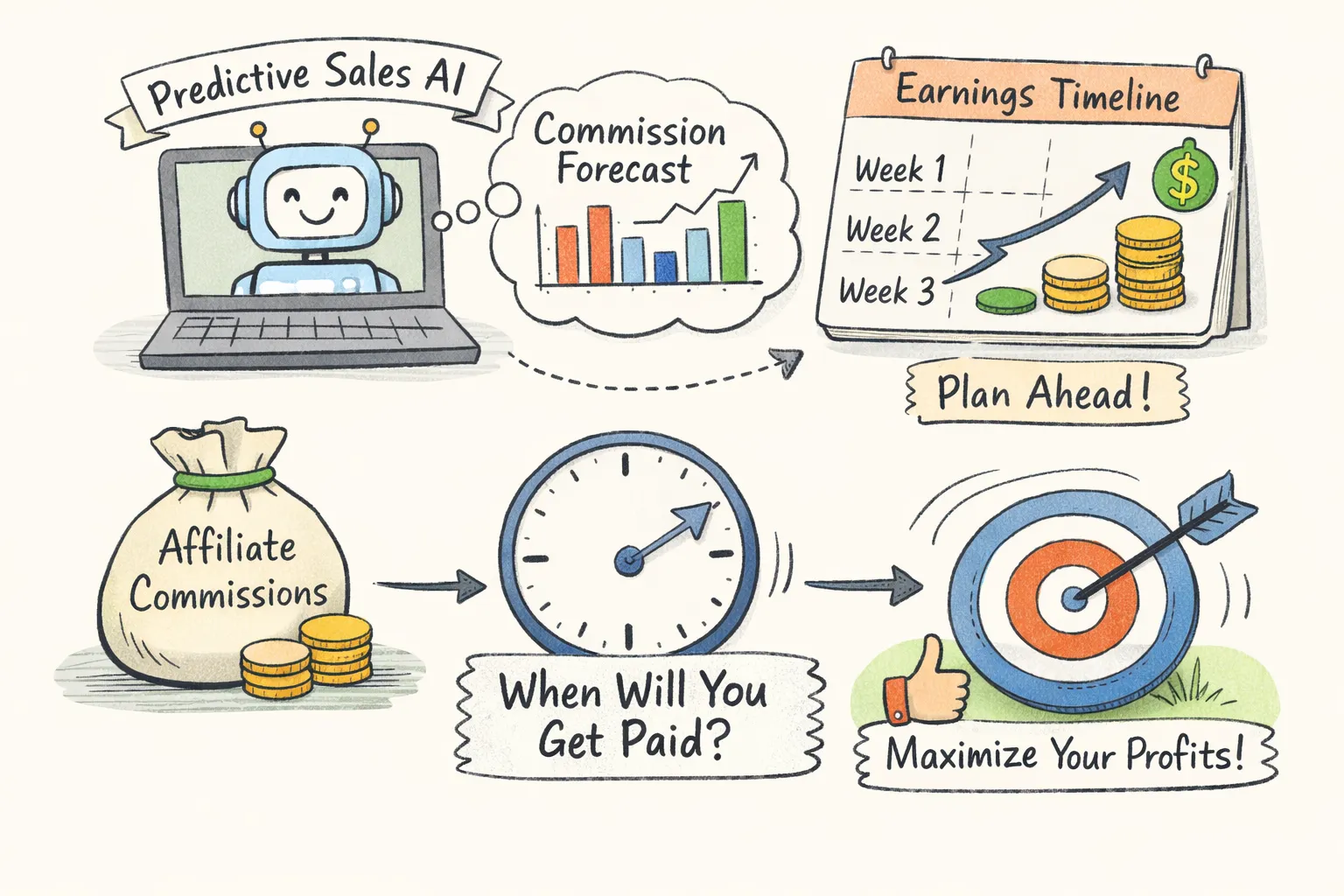
Missed paydays are a common problem when forecasting relies on spreadsheets and gut calls. predictive sales ai uses machine learning on historical conversions, engagement, campaign activity, and external signals to forecast revenue and deal outcomes. The models update as new data arrives so forecasts reflect recent campaign behavior and shifting audience intent. For affiliates the practical output is a daily or weekly commission projection you can schedule around and act on before a payday slips away.
The bottom line
Here are the essentials to decide quickly whether to test predictive sales ai on your funnels. Use these points to plan a focused pilot and judge results fast.
- Core benefit: predictive sales ai turns historical signals into scheduled commission projections so you can act before paydays slip away. It replaces guessing with probability-based revenue estimates you can use to time promos and prepare cash flow.
- Necessary inputs: feed clean conversion timestamps, campaign and UTM IDs, click/postback data, traffic volumes, and average order value. Connect tracking, ad, and payout systems so the pipeline stays reliable.
- How to act: convert probabilities into expected revenue, then schedule promos, reallocate spend, or pause low-return funnels. Make one change at a time and measure results against your baseline.
- Vendor checklist: prioritize integrations, explainability, retraining cadence, and measurable ROI over slick demos. Ask for short integration timelines and clear export options.
- Pilot steps: export 30–90 days of data, define KPIs, run a 4–8 week pilot, and compare predicted versus actual commissions. Use those results to validate ROI before you scale.
What predictive sales ai does for affiliate marketers
For affiliate marketers, predictive sales ai turns raw event streams into ranked commission forecasts with confidence scores you can use to prioritize work this week. Models learn which campaigns, creatives, and audiences drive revenue, send alerts when a promotion shows early slippage, and produce daily or weekly commission curves you can schedule around. Below are the core capabilities you will use and how each translates into immediate decisions.
For a practical daily workflow, read How to Use AI for Affiliate Marketing: A Real Daily Workflow.
- Probability-to-revenue forecasts: expected commission and a confidence range by campaign so you schedule promos on the highest-return days. Use expected revenue to set realistic cash-flow targets and size daily spend.
- Predictive lead scoring: ranks audiences by conversion likelihood so you focus creative and spend on top segments instead of pushing broad lists. Score thresholds tell you when to scale aggressive traffic versus when to nurture.
- Scenario testing: simulates shifts in ad spend, promo timing, or EPC so you can reallocate budget before running long tests. Run quick “what-if” runs to see how modest changes affect weekly commissions.
- Revenue intelligence: detects trend changes and early slippage so you stop losses by pausing or reworking low-return funnels. Alerts shorten the time between spotting a drop and taking corrective action.
How predictive models map to affiliate commissions
Predictive sales ai converts a predicted conversion probability into a dollar figure you can bank. Apply the predicted conversion rate to your traffic and average order value, then multiply by the commission rate to get expected commissions. For example: expected commissions = visitors × predicted conversion rate × average order value × commission rate, so 10,000 visitors × 1.5% × $100 AOV × 30% commission equals $4,500 for the period.
Well-built systems commonly reduce forecast error by 20–50% and can lift conversion when scoring focuses spend on high-propensity audiences, though outcomes depend on data quality and funnel maturity. For affiliates, the most meaningful metrics are reduced variance in weekly payouts and higher incremental commissions from prioritized segments—use those to compare vendors or in-house builds.
What data and integrations you need for reliable predictions
Good predictions start with the right raw signals. Capture conversion timestamps, campaign and UTM IDs, click IDs where available, payout per conversion, transaction value, landing page, device, and the attribution window for click and view lookback. Store both the raw event stream and cleaned transaction records so you can audit, retrain, and resolve mismatches without losing fidelity.
Each field matters because models learn which combinations of signals lead to revenue. Campaign and click IDs map outcomes back to creative and placement, while payout and timestamps let the model convert probabilities into expected revenue per event. Keep naming consistent so the model can group performance cleanly.
Behavioral and intent signals often lift model performance faster than demographic attributes. Track page depth, time on page, email opens and clicks, repeat visits, and relevant product usage events; these inputs help the model detect real buying intent rather than surface-level traits. Treat intent signals as first-class features when you build training datasets to capture short-term shifts.
Integrations tie the pipeline together: connect GA4, Meta Ads, affiliate network APIs or postbacks, payment processors like Stripe, and your CRM or a well-structured spreadsheet. Reliable server-side tracking or postbacks are essential to avoid lost conversions and broken attribution. If you use a CRM, confirm compatibility so predictions flow into workflows and rule-based automation. See CRM fields that will impact your predictive lead scoring model for a practical list of fields that improve scoring.
How to evaluate predictive sales ai vendors for affiliate use
Start with a practical checklist to cut through sales decks quickly. If you plan to use predictive sales ai for affiliate commissions, focus on integrations, explainability, and measurable ROI rather than marketing fluff.
- Native integrations with affiliate networks: direct connectors or easy CSV imports avoid custom engineering. Native mapping of click, lead, and commission fields prevents manual reconciliation work.
- Model explainability and refresh cadence: ask how often models retrain and whether scores are interpretable so you know why a lead or campaign ranks highly. Interpretable scores help you translate predictions into concrete actions.
- Scenario testing: the vendor should let you run “what if” scenarios for traffic changes, promo codes, or EPC shifts before you commit budget. That capability reduces the cost of experimentation.
- Commission projection dashboards: dashboards must translate probability into projected commissions by campaign, publisher, or date range so you can plan payouts and promos. Look for clear export and scheduling options.
- Data security and privacy: require SOC2 or equivalent and clear data retention and export policies. Know where your data lives and how you get it back if you leave.
- Transparent SLAs and support: require an SLA for uptime and data latency, plus a clear escalation path for issues. For small teams, a reachable technical contact speeds troubleshooting.
Red flags include opaque black-box scoring, long integration lead times, or vendors insisting all data stay proprietary. Avoid mandatory enterprise contracts or long engineering queues that slow pilots; insist on timelines, a technical contact, and a rollback plan before signing. These steps keep small operations moving at pace. For background on forecasting methods and expectations, see SuperOffice’s guide to predictive sales forecasting.
Expect three pricing shapes: enterprise quotes, per-user SaaS, or capped SMB tiers, and factor hidden costs like integration engineering, data warehousing, and tagging maintenance into your pilot budget. Run a short vendor test with a historical backtest and holdout period, measure MAPE (mean absolute percentage error) and conversion uplift, validate on fresh data, and require a demo that loads your sample export to show commission projections. Demand a 30-day pilot with clear exit criteria so you can move on quickly if the uplift does not materialize.
Implementation roadmap and pilot checklist to measure ROI
Phase 1 (weeks 0 to 2): prepare data and define KPIs. Map fields across your ad, tracking, and payout systems, remove duplicates, and confirm postback reliability so every conversion maps to an ID. Document attribution windows and record baseline KPIs such as weekly commissions, average order value, conversion rate, and churn where relevant. Set clear KPI targets to judge success, for example a 10 percent conversion uplift or a MAPE under 15 percent.
Phase 2 (weeks 3 to 6): run a focused pilot and measure accuracy. Run the model on one funnel, one traffic source, and one vendor to keep variables controlled, and compare predicted commissions to actuals over a predefined holdout period. Track MAPE and conversion uplift and use simple A/B tests that compare model-driven actions versus control, measuring lift with statistical significance. Treat these results as the primary estimate of incremental lift for your ROI calculation.
Phase 3 (weeks 7 to 12): scale and automate when the pilot hits targets. Automate real-time scoring, push predictions into scheduling and ad rules, and add monitoring dashboards with weekly variance alerts so you catch drift early. Train the people who will act on predictions and set a quarterly review cadence to recalibrate models and refresh data mappings. Automation without governance creates hidden risk, so maintain clear ownership and runbooks.
Follow a structured playbook like MIT Sloan’s AI playbook: 6 steps to launching predictive AI projects to reduce implementation risk and keep pilots focused.
Calculate affiliate ROI as (incremental commissions minus total tool and integration cost) divided by total cost. Estimate incremental commissions from model-backed A/B tests or reliable backtests and include one-time integration fees in total cost. For example, an extra $1,500 in monthly commissions at a $300 monthly cost equals a 400 percent return. Use these pilot phases and ROI checks to decide whether to scale or iterate on the model and integrations.
Common pitfalls and practical tips for steady commissions
Poor data hygiene, missing postbacks, mixed attribution windows, and ignored seasonality are the usual reasons forecasts fail. Dirty data creates noise, missing postbacks drop conversions off the record, inconsistent windows hide conversion timing, and seasonality shifts baseline conversion rates. Fix these issues quickly by standardizing field names, restoring postbacks, aligning attribution windows, and applying a simple seasonality multiplier to recent averages.
Three quick wins move the needle without new software: add clear payout values to tracking so commission math is accurate at source; tag campaigns with consistent UTM naming to group performance cleanly; and run a short backtest in a spreadsheet using the formula above to validate assumptions. Use this plug-and-play pilot checklist over the next 7 to 14 days: collect the last 12 weeks of conversion data, map campaign IDs and postbacks, run the backtest to check lift, pick one funnel to optimize, set KPI targets, and agree on clear success thresholds. Keep the scope tight: one funnel, one hypothesis, and one decision at the end so the pilot stays fast and conclusive.
If these problems sound familiar, see Why Affiliate Marketing Isn’t Working for You (And the Real Fix) for practical remediation steps that many affiliates overlook.
Plan your affiliate commissions with predictive sales ai
Predictive sales ai gives a practical way to turn uncertainty into a schedule you can act on. Feed clean conversion history and engagement metrics into a predictive model, then use expected conversions multiplied by your payout to produce projected commissions you can budget around. The result is simple: you stop guessing and start planning, and clean, connected data plus the right integrations make the math reliable.
Take the next step: export your last 30–90 days of conversions and traffic into a CSV, then plug those numbers into the free Predictive Sales AI workbook on InternetMoneyPro to forecast your next payouts and pick a single action to scale first. For an overview of predictive sales AI concepts and how teams use them, see this predictive sales AI guide from monday.com. If you prefer built-in projections and a guided 60–90 day plan, sign up for InternetMoneyPro’s predictive dashboard and follow the pilot roadmap above to measure ROI quickly. Start with a tight pilot, measure lift, and scale what works.
Leave a Reply