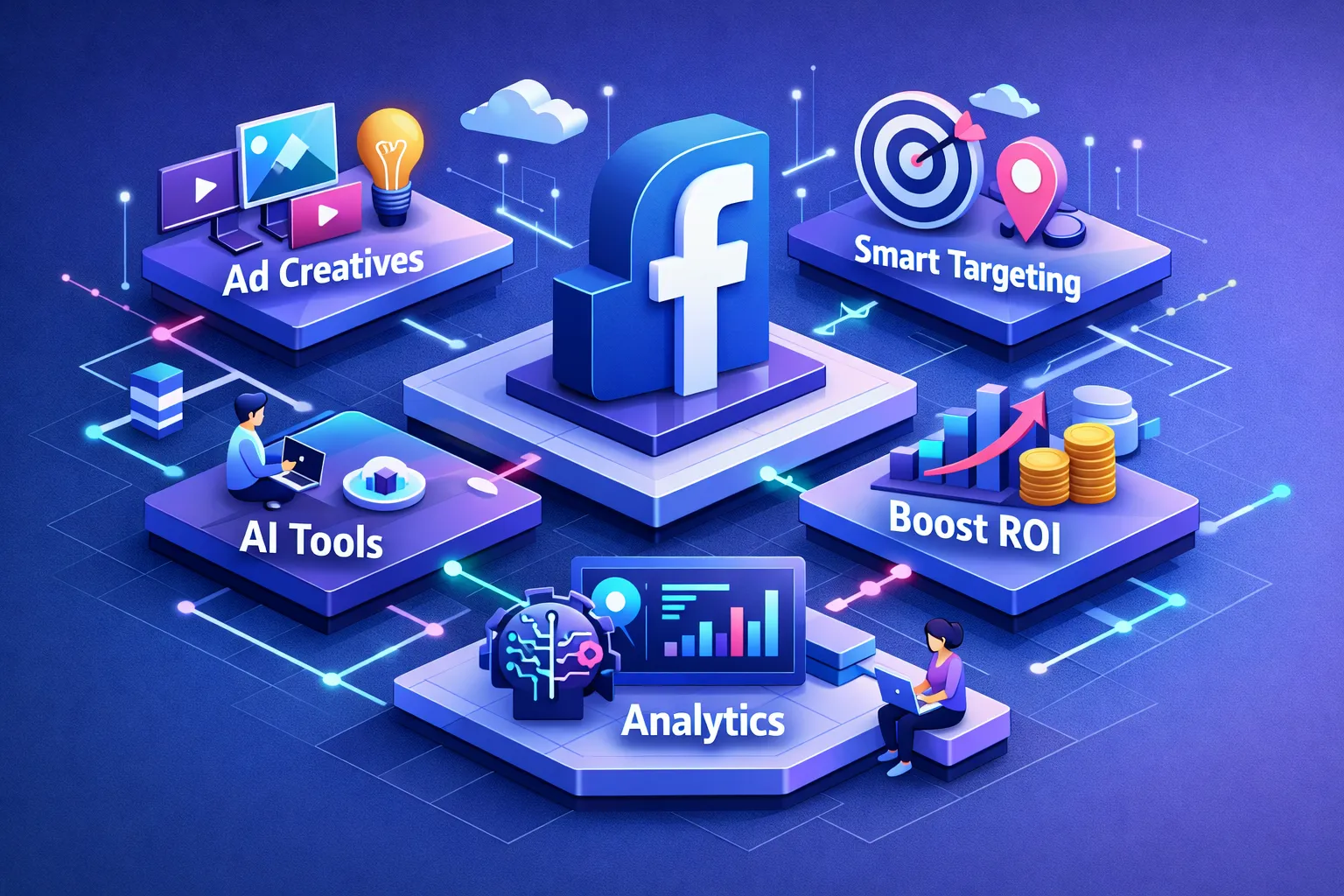
facebook ads ai reveals which creatives drive growth and which drain budget. AI tools for Facebook ads, from Meta Advantage+ to third-party ad generators and autonomous media buyers, make creative testing, targeting, and bidding faster. Below you’ll find seven practical tools and a single-offer playbook that improve creative automation, dynamic creative optimization, and bidding so you can scale with clearer results.
Quick summary
- Seven tools to try: Meta Advantage+, InternetMoneyPro templates, AI ad generators, creative automation and DCO platforms, Madgicx, AdStellar, and Revealbot.
- Single-offer playbook: choose one offer and one clear KPI (target CPA or ROAS), and record baseline metrics before changing creative.
- Clean signals first: install Meta Pixel and Conversions API, map purchases and value, and verify deduplication so Meta can learn properly.
- Tight seed audiences: use past buyers, recent converters, and high-intent engagers; prioritize recency and intent over audience size.
- Creative inventory and DCO: provide 6 to 15 varied assets (photos, short videos, UGC, headlines, and captions) and enable dynamic creative to test hooks quickly.
- Bidding and cadence: use one bid objective across tools, run three- to seven-day learning tests, then follow an eight-week plan to scale.
Quick start: single-offer playbook with facebook ads ai
Start small to get clear signals. Begin with one offer and a single measurable goal, choosing a product or promotion with a reliable landing page and known conversion flow. Record baseline metrics (average order value, conversion rate, and EPC) so you can measure improvement after changing creative and audience settings.
Feed the algorithm clean signals from day one by installing the Meta Pixel and setting up the Conversions API, mapping purchase, value, currency, and content_ids for proper deduplication and revenue tracking. Verify event delivery in Events Manager and fix missing-parameter warnings before you push budget so the learning phase does not waste time or money.
- Map purchase, value, currency, and content_ids
- Enable server-side Conversions API and deduplication
- Use Test Events and Events Manager verification
Once those basics are in place, use Advantage+ or your chosen prospecting approach to gather initial conversion data and keep setup mistakes to a minimum with proven templates. If you’re rebuilding campaigns from scratch and need a step-by-step reset, see Starting Over With Affiliate Marketing: The Second Attempt Blueprint | InternetMoneyPro. Then structure your creative inventory so dynamic creative optimization (DCO) has the variations it needs to surface winners across placements.
Audience segmentation: feed the AI signals it needs
Signal quality matters more than scale. Prioritize first-party signals such as past buyers, recent converters, and high-intent engagers, and export lists from the last 30 to 90 days. Segment those lists by action—recency and intent matter more than raw size—because a broad seed dilutes signal and makes lookalikes noisy.
Use Meta Advantage+ for prospecting when you have moderate data and want the system to find patterns. Choose manual lookalikes when you have a proven, high-value segment and need tighter control over match rate and exclusions. For a practical walkthrough on setting up Meta’s automated prospecting, see this Meta Advantage+ guide. Send CRM lists, lead-form results, and offline conversions into Ads Manager via the Conversions API so events tie back to revenue and include order IDs where possible for accurate value attribution. Integrate creative automation and DCO so the ad platform can match creative variants to audience signals across placements and surface winning combinations faster.
Turn data into a testing plan: export your best 30- to 90-day buyers, segment engagers by action, send order IDs through the Conversions API, and run parallel tests of automated audiences versus lookalikes. Monitor match rates and conversion value and scale the approach that consistently raises ROAS. When you settle on reliable seeds, move to creative testing with a clear bid objective.
Creative automation and dynamic creative optimization
Build a diverse creative inventory the algorithm can learn from. Aim for 6 to 15 assets—photos, short videos, UGC clips, distinct headlines, and 4 to 6 caption variants—and include different hooks or value propositions so the system has meaningful permutations to test.
Feed those assets into an AI ad generator or creative hub and enable dynamic creative optimization so the platform assembles permutations automatically instead of relying on manual A/B tests. Consider the top AI marketing tools when choosing a creative hub. Score creatives on hard metrics over a 7- to 14-day window and prune consistent underperformers. Track click-through rate, conversion rate, and cost per acquisition, keep the top performers, and rotate fresh variants to prevent fatigue while aiming for three to six winners.
Treat automated tools as assistants that surface likely winners rather than as decision-makers to trust without review. Review winning combinations, validate attribution, and update creative briefs where needed. Once hooks and formats prove reliable, pair them with tight audiences and a single bid objective before scaling.
Bid automation and smart scaling with AI media buyers
Translate your business goal into one bid objective and apply it consistently across tools. Use target CPA for a stable cost per acquisition or target ROAS for revenue-weighted growth. Set the same goal across platforms so signals do not conflict and facebook ads ai can optimize toward a single outcome.
Add third-party platforms like Madgicx, AdStellar, or Revealbot when you need autonomous bidding, cross-account scaling, or richer rule logic than Ads Manager provides. These tools can reallocate budgets and execute advanced rules, but factor vendor costs, often $49 to several hundred per month or a small percent of spend, into your CAC math before enabling automation.
Protect scaling with guardrails: daily caps, emergency pause rules, and rollback triggers to prevent automation from compounding mistakes. Include a manual override in your SOP, for example pause any auto-scale that increases spend more than 30 percent in 48 hours and require a 24-hour review before resuming. Pair these rules with a creative cadence so fresh ads support higher spend without degrading returns.
Measure, attribute and benchmark: stop guessing performance
Map key events such as purchases, leads, and value to the Conversions API and verify deduplication with the browser pixel so you recover conversions lost to privacy changes and sharpen optimization signals. Madgicx’s write-up on the Facebook Conversions API is a helpful technical reference if you need troubleshooting steps or implementation tips: Madgicx — Facebook Conversions API. Audit Events Manager weekly to catch drops, mismatches, or parameter changes before they skew reporting.
Treat directional benchmarks as rough guides, not guarantees. Reported uplifts vary by vertical, so validate numbers for your product; some advertisers report ROAS gains from 30 percent up to 150 percent and CPA drops of 20 percent to 40 percent after adding new tooling. Report absolute CPA and profit, not just relative lifts, and avoid declaring winners until you see stable performance across at least 50 conversions or two full learning cycles. Use three- to seven-day windows for routine decisions and scale only after targets hold for consecutive days.
When measurement and attribution are reliable, automated insights become usable for scale decisions. The following section presents an eight-week test plan that applies these principles step by step.
8-week step-by-step test plan using facebook ads ai
Start with a data-first approach in Weeks 1 and 2: prepare your creative inventory, install the Meta Pixel and Conversions API, and map key events so signals are clean before you spend. Launch a broad learning campaign sized to capture about 50 conversions in the test window; a simple rule of thumb is to multiply your target CPA by 50 to estimate the initial budget. Track early signals, confirm event delivery, and pause anything that shows missing parameters or poor match rates.
Weeks 3 and 4 focus on creative triage and audience work. Review ad-to-conversion paths, pause low-performing variants, and tighten or expand audiences based on where conversions come from. Use creative automation platforms to generate new variants and feed winning elements back into learning campaigns while keeping a shortlist of assets to rotate into scale tests.
Weeks 5 and 6 are for safe automation and controlled scaling. Turn on automated bidding or add a rules engine such as Revealbot with conservative caps and pacing to protect CPA, and increase budgets in measured steps, for example 20 to 30 percent every 48 to 72 hours once CPAs stabilize. Monitor attribution shifts so you can roll back quickly if costs drift above target.
Weeks 7 and 8 consolidate winners and expand systematically: move spend into top-performing creatives and audiences, add retargeting flows, and test lookalikes or adjacent segments at small scale. Lock dashboards and export raw data for a post-test analysis that feeds the next cycle. The plan succeeds when facebook ads ai has a single offer, clean events, and disciplined goals, so start Week 1 with the objective of reaching those 50 conversions.
Taking facebook ads ai from tools to ROI
Tools only matter if they move the bottom line. facebook ads ai multiplies results when you pair it with the single-offer playbook, tight seed audiences, and DCO-driven creative testing. For a systems-level perspective on building repeatable affiliate funnels and workflows, see What an Affiliate Marketing System That Works Actually Looks Like | InternetMoneyPro. When measurement is accurate and goals are consistent, the system surfaces the combinations that improve profit.
More practical templates, case studies, and ongoing advice are available on The Blog | Real Answers for Real Affiliate Marketers | InternetMoneyPro.
Leave a Reply