Most affiliate marketers approach AI marketing automation in one of two ways: ignoring it completely, or downloading every new tool the moment it trends on Twitter. Both approaches tend to produce disappointing results. The problem isn’t the technology. The problem is the lack of a system to plug it into.
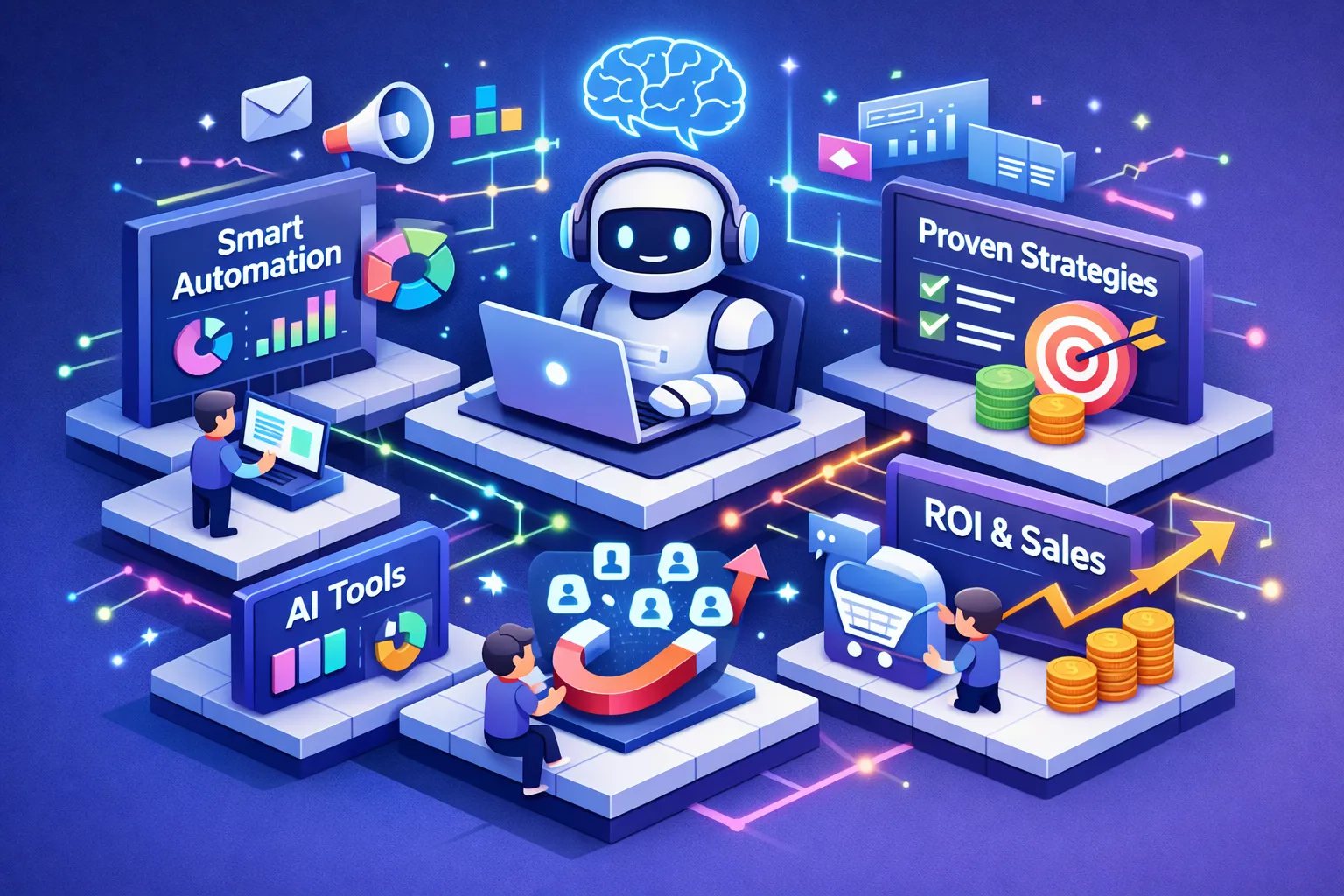
At InternetMoneyPro, the approach we teach is deliberately narrow: pick one offer, define your audience, and automate the parts of your marketing that eat the most time without producing proportional results. AI fits that model well, but only in specific places. The three that matter most for affiliate marketers are email drip sequences, social scheduling, and ad targeting. This article covers each one, with real ROI benchmarks and a straightforward way to start.
What AI marketing automation actually does differently
Traditional marketing automation runs on if-then logic. If someone opens an email, send the next one. If someone clicks a link, tag them. These rules work until they don’t, and when your list grows or your audience behavior gets unpredictable, the whole thing falls apart. The rules don’t adapt, you have to go back in and rebuild them manually, which defeats the purpose.
AI-powered marketing automation removes the static rule problem by replacing predefined conditions with machine learning. The system reads behavioral patterns across your entire audience, identifies what’s working, and adjusts campaigns in real time without you touching anything. Predictive marketing automation adds another layer: instead of waiting for someone to signal obvious buying intent, AI forecasts who’s likely to convert before they do, so your messaging reaches them at the right moment rather than after the window closes.
The efficiency gain is measurable. According to a 2023 Salesforce State of Marketing report, AI-assisted campaign workflows reduce launch time by 75 to 84 percent when handling content generation, audience segmentation, and scheduling. For affiliate marketers with no team and limited time, that gap between what you can manually manage and what your marketing actually needs to do is where AI earns its keep.
Email drip campaigns without the endless tweaking
Email is where AI marketing automation delivers the most immediate, visible impact for affiliate marketers. A standard drip sequence, built once with fixed timing and generic subject lines, performs fine at first and then plateaus. Most people don’t notice the plateau until they check conversion numbers six months later and wonder what changed. Nothing changed. That’s the problem.
AI solves this by treating your sequence as a dynamic system rather than a static document. The platform analyzes open rates, click behavior, and the specific points where subscribers drop off, then resequences emails based on individual engagement rather than a preset calendar. Send-time optimization means each subscriber gets your emails when they’re personally most likely to open them, not at 9 AM Tuesday because that worked on average. Subject lines, content blocks, and CTAs shift based on what each subscriber has already engaged with. That’s automated personalization, a fundamentally different outcome than swapping in a first-name token and calling it personalization.
The AI automation module inside InternetMoneyPro is built around this workflow. It handles sequence setup with minimal input, so you’re not spending weeks configuring logic rules before your first campaign goes live. The focus stays on what actually matters: the offer and the audience. A single focused drip campaign, built to convert and running without constant maintenance, is the version of email automation that consistently produces results. For a sense of the broader landscape of tools that make this possible, see a comparison of the best AI marketing tools.
Tools like ActiveCampaign and Klaviyo handle the mechanical side well, but the system behind the sequence determines whether AI optimization has anything meaningful to work with. Without a defined offer and a clear audience, you’re just automating noise faster.
What to set up first
Before configuring any AI marketing tools for email, nail down your audience segment and the single conversion action you want each email to drive. Every optimization the AI runs traces back to those two inputs. Fuzzy inputs produce fuzzy results regardless of how sophisticated the platform is.
Social media scheduling that doesn’t need a babysitter
Daily social media management is one of the most time-consuming, low-leverage activities in marketing. You’re posting, checking engagement, adjusting timing, and repeating the cycle every single day. AI removes most of that friction by analyzing platform-specific engagement windows and scheduling posts at peak times automatically. For affiliate marketers promoting a single offer, this means consistent distribution across channels without the daily management overhead.
The more useful capability is content variation. AI generates multiple versions of the same post using different angles, hooks, and formats, then rotates them to test what resonates with your specific audience. Weaker content gets deprioritized automatically as performance signals feed back into the system. Platforms like Blaze AI handle multi-channel scheduling at scale, though the real value isn’t the scheduling itself. It’s the feedback loop that tells you which content is actually worth creating more of. For practical advice on scheduling workflows and best practices, consult the best drip email marketing apps and scheduling guides that outline how to prioritize distribution without daily oversight.
Scheduling AI works best when the offer and audience are already defined. If you haven’t locked in what you’re promoting and who you’re talking to, automation just scales the confusion. Get those two things clear first, then let the tools handle distribution and variation testing.
Ad targeting that adjusts itself in real time
Broad demographic targeting burns budget. Most affiliate marketers know this, but without a better alternative they default to age ranges and interest categories and hope the algorithm figures it out. AI predictive targeting takes a different approach: it analyzes behavioral data to identify the micro-audiences most likely to convert, not the broadest possible group that might be interested.
Dynamic ads extend this further. Creative elements, copy, images, and CTAs, shift based on who’s viewing the ad and where they are in the funnel. Someone who clicked your landing page last week sees different messaging than someone encountering your offer for the first time. InternetMoneyPro’s AI automation module covers dynamic ad setup as part of the broader system, which helps members running paid traffic alongside organic channels spend less time on manual creative testing.
What the performance data shows
Real campaign results are worth knowing before you commit budget. According to Advolve’s published case studies, its AI-driven ad platform reduced operational work by 90 percent and increased ROAS by 15 percent for campaigns managing multi-million-dollar budgets. Industry research on generative AI for ad creative reports ROAS lifts of 15 to 20 percent and production time cuts from weeks to days. For a high-level industry perspective on how these automation approaches are being applied in enterprise marketing, see IBM’s overview of AI marketing automation.
These numbers reflect mature campaigns running on clean data, not day-one results from a fresh account. Start smaller and expect incremental gains before compounding returns.
What ROI from AI marketing automation actually looks like
The numbers from real deployments are genuinely strong, and they’re worth reviewing so you can calibrate expectations honestly. One e-commerce case study on AI-powered omnichannel automation documented a 25 percent increase in conversion rates, a 30 percent reduction in customer acquisition costs, and 300 percent ROI within six months. A separate 12-month implementation tracked a 31 percent improvement in conversion rates for recommended products and a 17 percent overall revenue uplift.
In a third example, an influencer marketing campaign using AI for discovery and performance analysis turned a $190,000 investment into $720,000 in revenue uplift, a 324 percent return. These cases span different channels and budgets, which suggests the underlying pattern holds across contexts rather than being a single outlier.
For beginners, the realistic timeline looks different. The first stage is efficiency gains: time saved on manual tasks, faster campaign launches, and lower cost-per-click from smarter targeting. Revenue uplifts follow once the system has enough behavioral data to optimize against. Industry data on first-time implementations suggests a payback period of two to six months, with year-one ROI ranging from 3.2x to 4x in areas like content production and ad management.
Set a 60 to 90-day window before judging AI automation performance. This aligns with the same timeline InternetMoneyPro builds into its commission milestone framework: the system needs enough cycles to learn and adjust. Cutting the experiment short at week three because results aren’t dramatic yet is how people end up concluding that AI doesn’t work, when the actual problem is impatience.
How to start without making it complicated
AI tools are only as good as the inputs they work with. Before adding any automation layer, you need clean first-party data: email engagement history, click behavior, and audience signals from your niche. You don’t need a massive list. You need behavioral signals from the right audience, even if that’s a few hundred engaged subscribers rather than thousands of cold contacts.
Start with one channel. Email automation is the right first move for most affiliate marketers because it has the clearest feedback loop and the most direct connection to commission activity. Get that producing results before layering in social scheduling and paid ad automation. Adding complexity before the foundation is solid doesn’t speed things up, it makes it harder to diagnose what’s actually working.
Many people struggle with marketing automation with AI not because the tools don’t work, but because they’re deploying features without a coherent system behind them. The InternetMoneyPro affiliate marketing system is built around the opposite approach: one focused audience, one offer, and AI tools layered in once the foundation is in place. If you’re still troubleshooting why your campaigns underperform, read Why Affiliate Marketing Isn’t Working for You (And the Real Fix) for common diagnosis and fixes. The AI automation module handles drip campaign setup and dynamic ad configuration with minimal technical input, making it accessible to beginners who are still learning the ropes, not just marketers who already have technical chops.
The actual takeaway
AI marketing automation isn’t about using every feature on every platform. It’s about identifying where automation removes the most friction for your specific situation and letting the system improve from there. For affiliate marketers, those places are email, social scheduling, and ad targeting. Everything else can wait.
The technology is real and the ROI benchmarks are legitimate. But the results belong to people who have a system to plug the tools into, not people who are still experimenting with tactics. If you want a structured starting point with AI marketing platforms built in from day one, an affiliate marketing system that works, and the broader InternetMoneyPro blog, are worth a close look. The platform is designed specifically for affiliate marketers who want predictable results without spending months on technical setup.
Leave a Reply