If you’re searching for the best AI tools for marketing, the first thing worth knowing is this: most affiliates don’t have a tool problem. They have a too-many-tools problem. The average affiliate marketer is paying for five or six AI subscriptions and getting consistent results from exactly none of them. That’s not a budget issue. It’s a focus issue. Tools without a workflow are just expensive distractions.
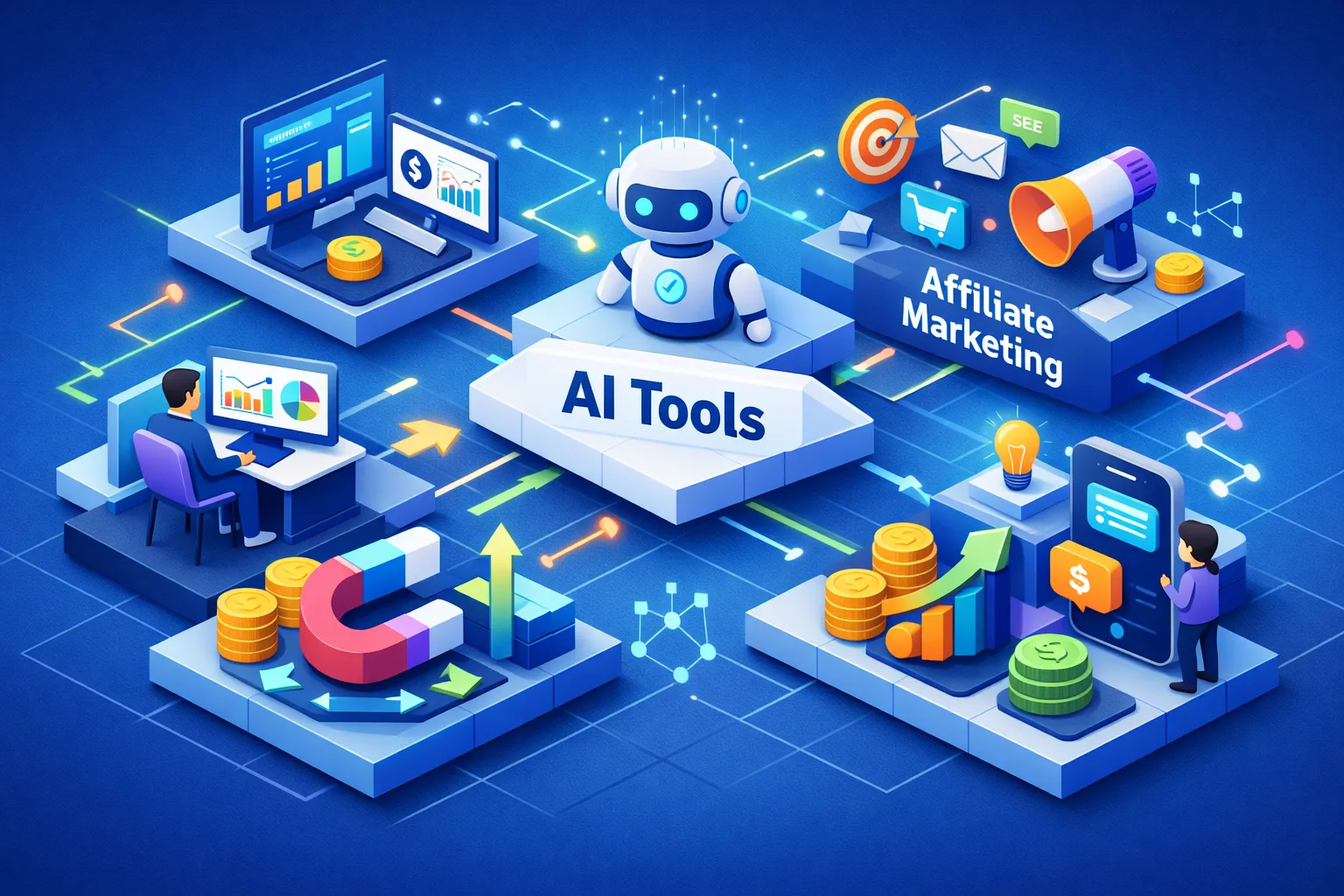
This guide covers the strongest AI marketing tools across four specific functions: content creation, SEO, paid ads, and analytics. Each one is evaluated on what it actually delivers inside an affiliate workflow, not what it looks like on a product page. By the end, you’ll have a clear 2, 3 tool shortlist to trial based on where you are right now and what your workflow is actually missing.
One thing worth naming upfront: a stack of tools is not a system. The affiliates generating predictable commissions are using fewer tools, not more. They have a process. The tools serve that process. Keep that in mind as you read.
Best AI Tools for Marketing: Content Creation That Produces Affiliate-Ready Copy
Content is where most affiliates spend the majority of their time, and it’s where AI delivers the most obvious leverage. The question isn’t whether to use AI copywriting tools. It’s which one fits the type of content you’re actually producing.
Jasper AI is the strongest option for affiliates writing long-form product reviews and comparison posts. It comes with 100+ marketing-specific templates, brand voice customization, and a structured approach to promotional copy that generic tools don’t match. The limitation is real though: without sharp, specific prompts, Jasper defaults to generic output. It rewards affiliates who know their audience and product well. It doesn’t compensate for vague direction. Pricing starts at $59/month on annual billing, with a 7-day free trial available.
ChatGPT works best as a research and drafting assistant, not a publish-ready content engine. Use it for ideation, outlining, and first-pass drafts. The hallucination risk is significant in affiliate contexts specifically: ChatGPT will confidently generate incorrect product specs, outdated pricing, and fabricated feature comparisons. Any AI-generated product claim needs manual verification before it goes live. Broken trust with your audience kills conversions faster than any algorithm update.
For affiliates who need volume on a tighter budget, eesel AI generates SEO-optimized blog posts from a single keyword, and Copy.ai handles headlines, CTAs, and short-form ad copy efficiently. Neither replaces Jasper for nuanced review content, but both hold up well for supporting pages and campaign copy.
AI SEO Tools That Tell You Exactly What to Write and Rank For
Ranking affiliate content is how passive commissions happen. The best AI tools for marketing in this category take the guesswork out of what to write and how to structure it to compete against established pages. If you’re serious about organic traffic, AI SEO tools belong in your stack.
Surfer SEO: Real-Time Optimization for Competitive Niches
Surfer SEO is the clearest choice for affiliates optimizing review-style content in competitive niches. It scores your draft in real time against top-ranking pages, flagging keyword density, content gaps, heading structure, and entity coverage. It also includes a built-in AI writing assistant and auto-optimization features, which makes it practical for affiliates producing content at volume. Plans start around $89/month on annual billing. For most solo affiliates, the cost pays for itself once the content starts ranking consistently. For a direct feature comparison with Clearscope, see Surfer SEO vs Clearscope comparison.
Clearscope and MarketMuse: Building Topical Authority
Clearscope and MarketMuse both focus on topical authority rather than individual post optimization. Clearscope suits affiliates in niches where ranking one post isn’t enough and you need to build out a content cluster that signals depth to search engines. MarketMuse maps those clusters and identifies gaps in your coverage over time. Both are premium-priced, with Clearscope starting at $170/month. They make more sense for affiliates with an existing content base who are trying to compound their rankings, not for those just starting out.
Free tools still have a place here. Google Analytics 4 includes predictive AI features that most affiliates ignore, including purchase probability scores and high-converting audience segments. Ahrefs’ free tier covers basic keyword discovery. These don’t replace a dedicated SEO tool at volume, but they’re worth using before you commit to a paid subscription.
AI Ad Optimization Tools for Automating and Scaling Paid Traffic
Affiliates running paid traffic face a specific challenge: creative fatigue and manual bid management eat time that should go toward scaling. These AI ad optimization tools address that directly.
AdCreative.ai: Speed-to-Creative for Multi-Variant Testing
AdCreative.ai generates ad visuals and copy variants optimized for click performance across Facebook and Google display formats. Its strength is speed for multi-variant testing, which matters when you’re promoting one offer across multiple audience segments. Plans start at $29/month, making it accessible early in a paid traffic journey. The limitation is worth noting: it performs best when you give it a defined audience brief. Feed it a blank prompt and the output is generic. Feed it specific audience pain points and offer details and it produces usable creative fast.
Gumloop: Workflow Automation Without the Technical Setup
Gumloop is the tool for affiliates who want to automate repetitive campaign tasks without writing code. Its drag-and-drop builder connects to GPT-4, Claude, and Grok without requiring separate API keys, which eliminates the technical setup that stops most beginners. Pricing starts at $97/month for the full automation suite. Use it to automate pulling ad performance data, briefing new creatives, or routing campaign reports. It’s not an ad platform. It’s the connective tissue between your tools that removes manual work from your weekly process. Read a practical example of how Gumloop accelerates GTM.
Persado and Phrasee both use data-driven copy testing to refine ad language based on performance patterns. These are more relevant for affiliates with existing ad spend and historical data to train the models on. Both are enterprise-tier in pricing and suited to affiliates managing larger budgets. If you’re early in your paid traffic journey, start with AdCreative.ai and Gumloop, then layer in copy testing tools once you have baseline data to work from.
Analytics Tools That Show You What’s Actually Working
Most affiliates fly blind on attribution. They know their commissions. They don’t know which content, traffic source, or creative is actually driving them. These tools fix that. See a set of AI marketing case studies showing real ROI for examples of measurable impact.
Brand24 tracks mentions, sentiment shifts, and media coverage across social platforms and the broader web. For affiliates in trust-sensitive niches like health, finance, or software, reputation signals directly affect conversion rates. Knowing when sentiment shifts around a product you’re promoting gives you time to adjust your positioning before it hits your commissions.
Atlas AI builds multi-touch attribution models that connect top-of-funnel content to bottom-of-funnel commissions. It removes the guesswork on which channel actually deserves your next budget increase. For affiliates running multiple traffic sources, that clarity is worth more than another content tool.
GA4’s predictive AI features remain underused across the board. The built-in purchase probability scores and predictive audience segments let you identify your highest-converting traffic without adding a third-party analytics subscription. If you’re not using these features inside GA4 already, start there before paying for an additional analytics layer.
Why Tools Without a System Still Leave Money on the Table
Here’s the pattern that keeps affiliates stuck: they add tools reactively. A new AI marketing automation platform launches, promises to automate results, and lands on the stack. Six months later there are five subscriptions running, fragmented data across three dashboards, and no clear picture of what’s actually working. This is tool fatigue. It’s common and it’s expensive. This pattern is covered in detail in Why Affiliate Marketing Isn’t Working for You (And the Real Fix) | InternetMoneyPro.
AI marketing automation doesn’t compensate for a broken affiliate workflow. Tools execute a system. They don’t replace one. An affiliate who knows exactly which audience they’re targeting, which single offer they’re promoting, and where their workflow breaks down will get more from two tools than a scattered affiliate gets from ten. That’s how it works in practice.
That’s the gap What an Affiliate Marketing System That Works Actually Looks Like | InternetMoneyPro was designed to address: a diagnostic affiliate system that identifies exactly where your workflow breaks down, whether that’s at the content stage, the traffic stage, or the conversion stage, and then integrates AI tools at precisely those points. Instead of running five disconnected subscriptions, you run two or three tools inside a repeatable process that builds toward predictable commissions. The system tells you what to fix. The tools do the work of fixing it faster.
Building your shortlist works like this: pick one content tool, one SEO or analytics tool, and one automation or ad tool. Map your choices to your current stage:
- Beginners (no existing content or audience): ChatGPT for drafts, Surfer SEO for optimization, Gumloop for automating repetitive tasks
- Affiliates with some content but inconsistent traffic: Jasper for content quality, Surfer SEO for ranking strategy, GA4 predictive features for traffic analysis
- Affiliates running paid traffic: AdCreative.ai for creative testing, Atlas AI for attribution, Gumloop for workflow automation
The stack size is not what drives commissions. The clarity of the process is.
The Affiliates Winning in 2026 Aren’t Using More Tools
They’re using the right tools inside a focused system. Generative AI for marketing has made genuinely strong options available in every category covered here. Content tools, AI SEO tools, ad optimization tools, and analytics tools all have solid picks right now. The problem was never the options. It was the absence of a process that tells you which ones to use, when to use them, and how to know they’re working. For a wider industry roundup, see Campaign Monitor’s best AI marketing tools comparison.
The four categories covered here, content creation, SEO, ad optimization, and analytics, cover every meaningful leverage point in an affiliate workflow. Your 2, 3 tool shortlist should address the stage where you’re currently losing commissions. One gap, one fix, one tool at a time.
The best AI tools for marketing only move the needle when they’re deployed inside a system that’s already clear on its goals. If you want the framework that tells you exactly how to use these tools inside a working affiliate workflow, that’s what InternetMoneyPro is built to deliver. A focused process, a diagnostic framework for fixing what’s broken, and AI integration at every stage that actually moves the number. No guesswork. No random stacking. Start with the system.
Leave a Reply