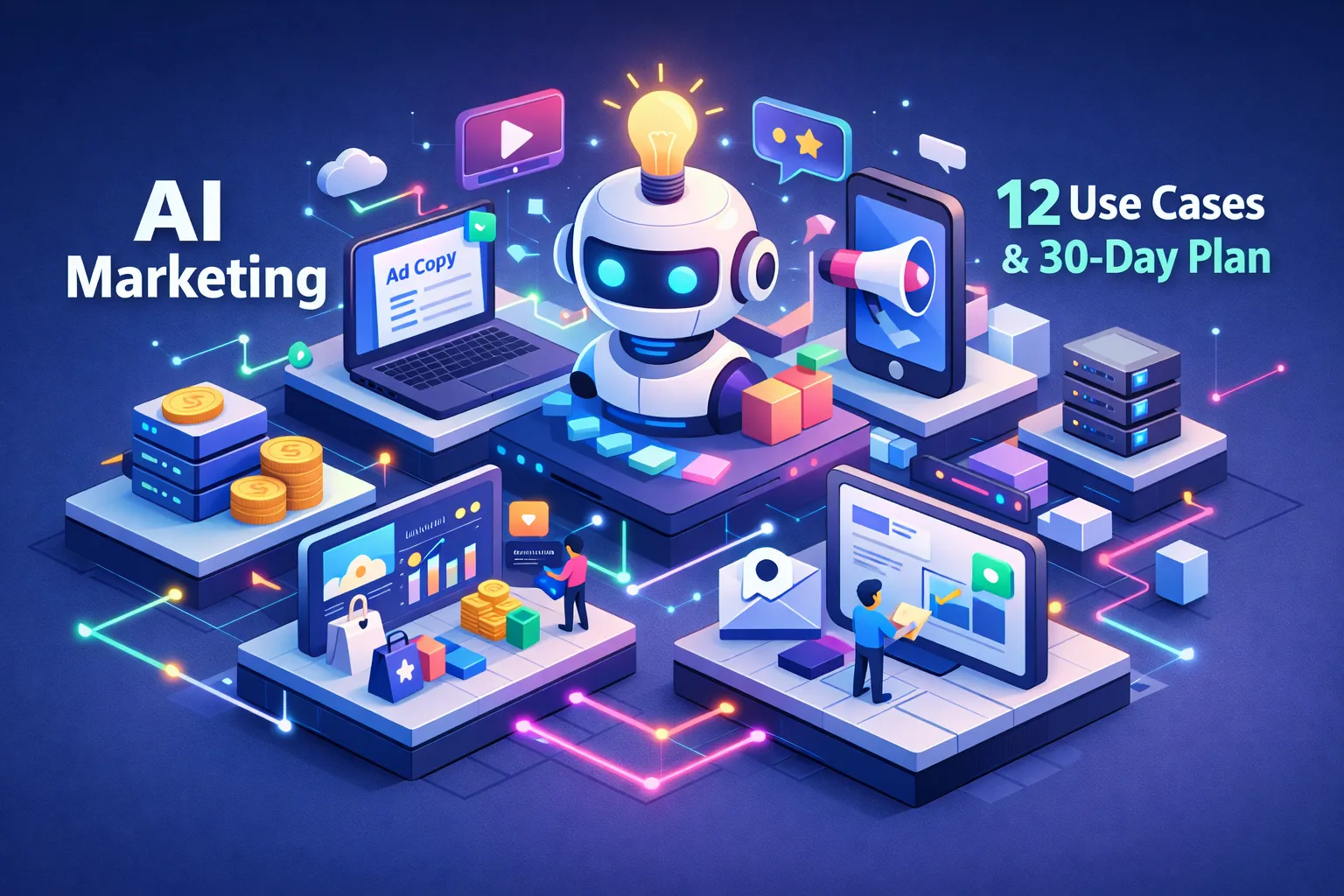
Generative AI for marketing can be the fastest lever affiliates use right now to automate content, personalize ads, and shorten launch cycles. At InternetMoneyPro we ran pilots that turned those capabilities into repeatable steps focused on measurable wins you can run this month.
You will walk away with three practical assets: a prioritized list of generative ai for marketing use cases that move affiliate funnels, a simple ROI checklist and payback formula, and a week-by-week 30-day playbook you can run immediately. The examples include AI-generated content, personalization patterns, automation setups, and prompt templates that cut creative setup time. Follow conservative benchmarks from recent pilots to model expected lift and start capturing predictable gains this quarter.
The bottom line
Start small and keep decisions simple so you get fast feedback and avoid wasted spend. Prioritize personalized ads, dynamic visuals, recommendation-driven commerce, and automated engagement for measurable lifts.
- Start small: pick one offer and run a controlled pilot with clear success criteria.
- Prioritize use cases that map to clicks, conversions, revenue, or hours saved.
- Measure payback: calculate payback days and projected ROI before you scale.
- Engineer prompts to speed iteration: generate three headlines and one short ad per offer.
Expect visible progress within 60 to 90 days when you follow a repeatable system and focus on one offer at a time. Use the playbook below to move from experiment to scale.
Main content
Generative AI changes how marketers create, test, and deliver messages by making creative work repeatable and measurable. Top applications are personalized content creation, dynamic ad generation, product visualization, and automated customer engagement using tools like Google Gemini, DALL·E, and modern large language models. These approaches scale output while keeping manual effort low. For a broad catalog of real-world examples you can adapt, review Google Cloud’s collection of generative AI use cases.
Focus on four starting points and measure lift by cohort or channel: personalized ad campaigns, dynamic creative optimization, product visualization, and customer engagement automation. Personalized campaigns match headlines and imagery to segments at scale, dynamic creative optimization assembles and tests many variations, product visualization produces lifestyle assets for ads and listings, and automated engagement handles FAQs, upsells, and micro-conversations. Set up tests so you can attribute gains to specific changes in creative or targeting.
High-value roles
Start with plays that answer direct business questions: get more clicks, lift conversion, scale creative output, or reduce response time. Personalized ads and creative at scale often deliver the clearest wins because small relevance improvements compound across volume. The repeatable pattern is simple: segment audiences, generate variants, and let data pick winners. If your affiliate channels are underperforming, our post Why Affiliate Marketing Isn’t Working for You (And the Real Fix) outlines common failures and the practical fixes we use in pilots.
Product visualization and storefront personalization are powerful conversion levers, and turning catalogs into short videos or lifestyle images shortens the path to purchase. Customer engagement automation extends reach without adding headcount when you embed LLM-driven assistants on high-intent pages. Run narrow pilots, measure CTR and conversion lift, and scale templates that show clear payback.
Operational tasks
Real-world use cases cluster around three operational tasks where generative ai for marketing replaces manual scale work with predictable outputs: making creative repeatable, turning catalogs into commerce assets, and automating conversations. Each task maps to straightforward KPIs so teams can test quickly and scale what works. Below are practical notes and realistic expectations for each play.
Personalized ad campaigns and creative generation: Map core audience segments, generate three headlines and three image variants per segment, pair with two CTAs, and run A/B tests. Track CTR, CPA, and conversion rate by segment to compare performance across cohorts. A properly configured pipeline can replace months of manual design with a small set of high-quality variants.
Product visualization and commerce optimization: Prioritize SKUs by margin and traffic, generate lifestyle images or 6 to 15 second videos, and replace static assets in top listings to test impact. Measure changes to search position and conversion after swapping richer visuals into pages with the most traffic. When done at scale, tailored visuals often shorten the purchase decision and lift daily revenue.
Conversational and recommendation systems: List common purchase intents and friction points, craft prompts for micro-conversations, and embed LLM-powered assistants on high-intent pages. Measure session-to-conversion, cart recovery, and average order value to see direct revenue impact. Keep a human reviewer in the loop during early testing to catch quality issues and handle edge cases.
Practical use cases
Here are the most practical generative ai for marketing use cases you’ll test in pilot work. Each maps to a clear metric: clicks, conversions, revenue, or hours saved. Use this list to prioritize pilots based on data readiness and expected payback.
- Personalized ad copy and creative variants
- Dynamic creative optimization (DCO) across formats and placements
- Product visualization: lifestyle images and short videos
- Catalog-to-content automation for listings and feeds
- Recommendation-driven commerce and cross-sell engines
- LLM-powered chat assistants for high-intent pages
- AI-generated landing page variants and funnels
- Audience segmentation and persona synthesis from first-party data
- Email subject lines and personalized email bodies
- Social content repurposing and short-form scripts
- Localized creatives and regional messaging at scale
- Automated creative pipelines with prompt templates and governance
Personalized ad campaigns tend to show the fastest ROI because they directly improve relevance and CTR at scale. Case pilots often report double-digit CTR lifts and reduced creative production time when teams replace manual design cycles with model-driven variants. Prioritize pilots that target pages or ad sets with enough volume to show meaningful changes within a week.
Automation and solid prompt engineering keep creative fresh while lowering operational load. Chat assistants, localized variants, and dynamic ad combinations require governance and quality checks to maintain brand voice and legal compliance. Start with templates, iterate on prompts, and only expand successful flows into your content library.
How to prioritize and test
Match the play to your biggest bottleneck: if acquisition falters, start with personalized ads and dynamic headlines; if conversion lags, prioritize product visuals and automated recommendations. Score opportunities by data readiness, expected ROI, and hours saved to decide what to build first. A simple scoring matrix keeps choices objective and repeatable.
Run short A/B tests with clear sample sizes and a human-in-the-loop for quality control. Iterate on prompts and templates rather than rebuilding flows from scratch to accelerate results. Track conversion lift, cost-per-acquisition, and creative velocity to judge whether a template is worth scaling. For guidance on which KPIs to track and how to structure measurement, see Google’s deep dive on measuring gen‑AI success: a KPIs deep dive.
Ship small and measure payback days before you increase spend. Establish governance upfront for copyright, consent, and brand review to avoid rework. Let real results guide scaling decisions rather than chasing every new tool.
Take action with generative AI for marketing
Below is a concise operational checklist, a simple payback formula, and a 30-day playbook you can execute without heavy technical overhead. Collect baseline metrics and model expected incremental revenue before you allocate media spend. Use short tests to protect budget while you validate templates.
ROI checklist: Collect baseline CPA, baseline conversion rate, average order value, gross margin per order, daily traffic to test pages, creative and tool setup costs, and planned media spend. Plug these values into a simple model to project incremental revenue and time to payback. Use conservative estimates so you can make quick scale/no-scale decisions after a week of results. For industry perspectives on AI ROI and benchmarks, review Snowflake’s analysis of ROI for generative agentic AI and the Marketing AI Institute’s AI ROI report.
Payback formula: Payback days = (one-time setup cost + test media spend) / (incremental gross profit per day). Incremental gross profit per day = expected daily incremental conversions × (average order value × margin). For a quick ROI check, projected ROI (%) = (incremental revenue − incremental cost) / incremental cost × 100.
Prompt rules: keep tasks specific, set tone and constraints, and ask for multiple variations. Example headline prompt: “Generate three headlines under 35 characters for [product] targeting [audience], emphasize [benefit], include urgency if applicable.” Example short ad prompt: “Write one 25-40 word social ad for [product], include clear CTA and one primary benefit, conversational tone.” For images, try: “Produce a 4:5 lifestyle image of [product] being used by [persona] in [setting], natural lighting, focus on usage context.”
30-day playbook: run these weekly tasks to generate content, test, and scale winners. Keep each pilot narrow and focused on measurable pages or ad sets. Prepare tracking before launch so results are attributable from day one.
- Week 1: Plan and baseline, choose one offer, capture baseline metrics, map audience segments, and rank three pilot pages or ad sets by traffic and impact.
- Week 2: Create and set up, generate three headlines, three image/video variants, and one short ad per segment; build two variants for an A/B test and prepare tracking (UTMs, conversions).
- Week 3: Run and optimize, launch tests, monitor performance daily for anomalies, iterate on top-performing creative with one or two prompt adjustments, and keep human review in place.
- Week 4: Analyze and scale, calculate payback days and projected ROI, scale winners, and add successful templates to your content library.
Execution beats chasing every new tool. If you want a guided template and diagnostic framework, see our How to Use AI for Affiliate Marketing: A Real Daily Workflow for step-by-step checklists and AI-enhanced prompts to help beginners reach their first commissions within 60 to 90 days. For broader resources and ongoing support, visit Affiliate Marketing That Actually Works | InternetMoneyPro.
Leave a Reply