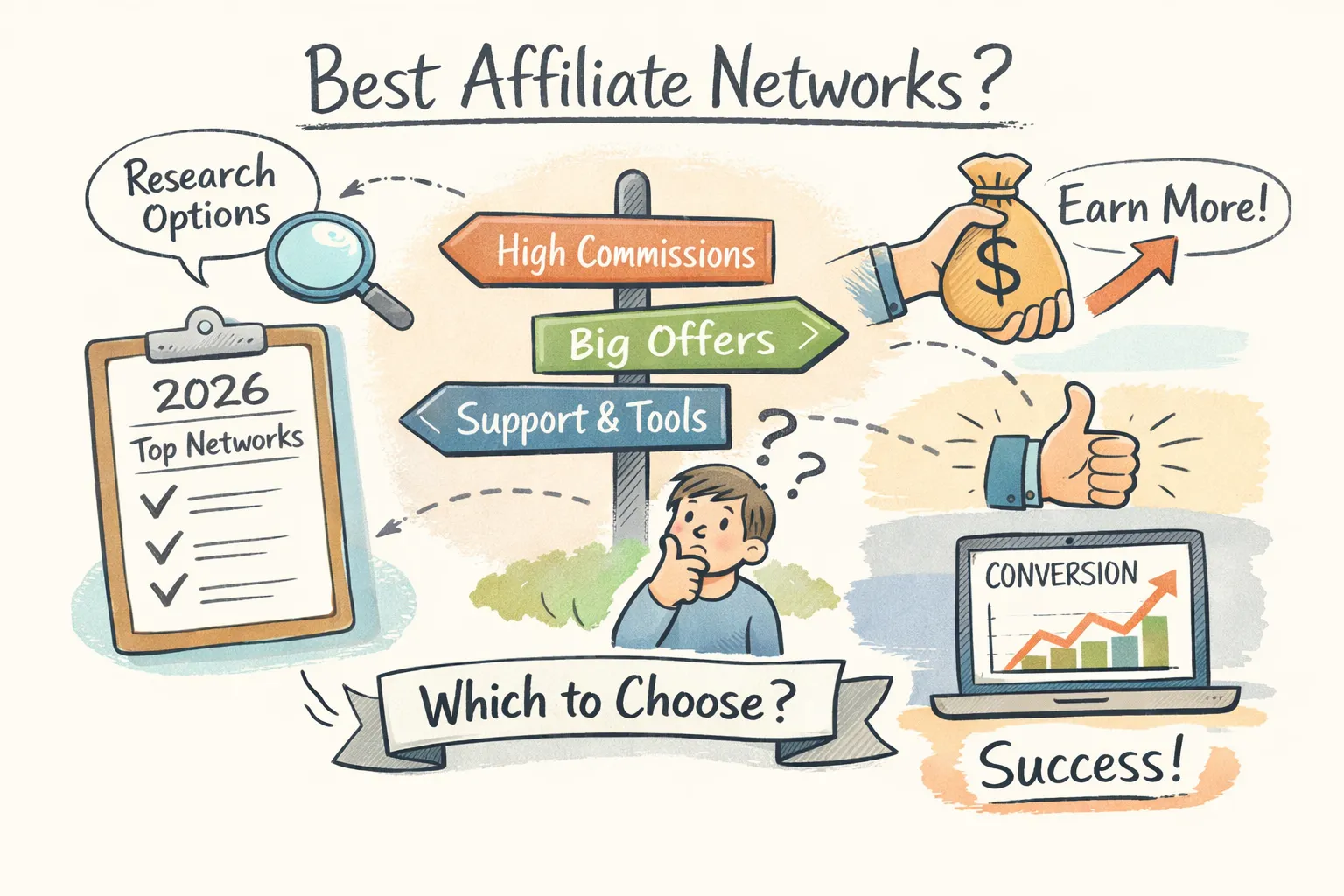
Joining more affiliate networks doesn’t make you more money. It makes you scattered. Most affiliates struggle not because they picked the wrong network, but because they never built a real system around their choice. They sign up for five platforms, grab a dozen links, publish a few posts, and wonder why nothing converts. The top affiliate networks all have something to offer, but the one that works for you depends entirely on your niche, your traffic source, and how you plan to move visitors toward a commission.
This article breaks down the leading partner networks by the metrics that actually matter: cookie windows, EPC, commission structures, payout terms, and approval difficulty. By the end, you’ll have a clear shortlist of two or three that fit your situation, and you’ll know exactly how to move forward with one of them.
What Separates a Good Affiliate Network from a Great One
The Core Metrics Most Affiliates Ignore
Cookie window length, EPC (earnings per click), attribution model, and tracking reliability determine what you actually earn from the traffic you send. A 40% commission with a 24-hour cookie can underperform a 20% commission with a 90-day window, particularly in niches where buyers research before purchasing, this is a common pattern in longer consideration-cycle categories like finance and software.
EPC is the single most honest indicator of a network’s earning potential for a given offer. It collapses commission rate, conversion rate, and average order value into one comparable number. Finance affiliates average $2.80 EPC across major networks, among the highest of any vertical. SaaS programs on platforms like Impact average $1.20 to $3.50, depending on product pricing. Ecommerce, anchored by Amazon’s 1, 10% rates and 24-hour cookie, sits well below both. When you’re comparing offers, EPC tells you more than the headline percentage ever will.
The Operational Details That Kill Momentum
Payout thresholds, payment schedules, and available payment methods affect cash flow more than most beginners expect. A network running NET-60 payment terms on a $100 minimum threshold can leave a new affiliate waiting three months for a first payment. That’s a long feedback loop when you’re just starting out. Most major networks pay via PayPal, ACH transfer, SEPA bank transfer, Wise, or Payoneer. Standard minimums run $50 to $100, with monthly or bi-weekly schedules and NET-30 being the most common timing for commission approval.
International wire transfers add fees and can delay payments by an additional week. If you’re outside the US, Payoneer or Wise will typically serve you better than waiting on a wire. Know these terms before you commit to a network, because they shape your cash flow reality in the first 90 days.
Top Affiliate Networks Compared: Volume vs. Performance
Volume Players: CJ Affiliate and Awin
CJ Affiliate connects over 167,000 publishers with more than 3,800 global brands. Awin operates at a larger scale, with over 30,000 advertisers and more than 1 million publishers across its network. Both suit affiliates targeting mainstream ecommerce and retail niches. Awin’s Conversion Protection Initiative, which mandates server-to-server tracking, gives it a measurable edge in attribution accuracy. The company reports recovering over $250 million in previously untracked revenue since launching that initiative. If tracking reliability matters to your business model, that’s a significant differentiator.
Approval on both platforms is moderately selective. They review traffic sources and site quality, but neither is a locked door for a publisher with a real content site and a clear niche. Dashboard usability varies: Awin’s interface is functional but dense; CJ’s reporting tools are strong, especially for comparing merchant performance. Cookie windows on both platforms are set by individual merchants, not the network itself, so a 30-day window is common but not guaranteed.
Performance-Focused Networks: Impact, ShareASale, and PartnerStack
These three networks lean toward SaaS, software, and direct-to-consumer brands with recurring commission structures. Impact supports flexible attribution models and detailed reporting, making it a solid choice for publishers who want to understand exactly where their earnings come from. PartnerStack is the clearer option for B2B SaaS programs. G2 data rates it at 8.9 out of 10 for commissions and payouts, compared to Impact at 8.6, and its dashboards are built specifically around recurring revenue tracking. If you’re writing about software tools or business productivity, PartnerStack gives you access to programs that pay recurring commissions for years, not just on the initial sale.
ShareASale remains one of the most accessible platforms for newer publishers. Approval barriers are low, merchant variety is wide, and the interface, while dated, is straightforward. It works well as a starting point for general content creators who haven’t yet built enough traffic to qualify for stricter networks. Home goods, fashion, and lifestyle programs, for example, are well-represented in its merchant catalog.
CPA Networks: MaxBounty and ClickDealer
MaxBounty runs over 30,000 verified affiliates across 2,000-plus active campaigns, mostly structured around pay-per-lead and CPA models. ClickDealer focuses on mobile and performance marketing. Both networks offer faster payout cycles than most affiliate marketplaces, which appeals to publishers with high-volume traffic. The trade-off is that approval is stricter. MaxBounty requires a multi-page application, government-issued photo ID, and a phone interview. Vague answers about your traffic source or promotion plan will get you rejected. These networks scrutinize traffic quality closely, and campaigns can be paused if your leads don’t convert at acceptable rates.
Payouts by Vertical and When Money Actually Lands
Commission Structures Across the Main Niches
Finance is the highest-paying vertical by average rate at 35 to 40%, driven by high-ticket products like loans, insurance, and investment accounts. SaaS programs offer strong compounding income through recurring structures. HubSpot pays 30% for up to one year. Moosend offers up to 40% lifetime recurring. Kinsta pays $50 to $500 upfront plus 5 to 10% lifetime revenue share. These aren’t one-time payouts. They stack month after month as long as the customer stays subscribed.
Ecommerce sits at the bottom. Amazon Associates pays 1 to 10% depending on category. eBay Partner Network runs 1 to 4%. Most direct-to-consumer brands cap at 10 to 20%. iGaming sits in between, with revenue-share models that can reach 20 to 50%, though the niche comes with compliance complexity in regulated markets. Pick your vertical deliberately. The commission structure you start with shapes how long it takes to see meaningful income.
Approval Requirements and Why Publishers Get Rejected
Networks with Open Doors versus Strict Gatekeeping
ShareASale and ClickBank have among the lowest barriers for new publishers. ClickBank’s tracking model uses HopLinks, device fingerprinting, and an attribution script, making it technically accessible for beginners promoting digital products. CJ Affiliate and Awin sit in the middle tier: they review your site and traffic sources but don’t require proof of prior earnings. Impact and CPA networks like MaxBounty are the most stringent. They want a live site with real content, a clear traffic explanation, and in many cases, demonstrated results before they approve you.
The Most Common Reasons Applications Get Declined
Thin content is the most common rejection trigger across networks. If your site has sparse posts, placeholder pages, or content that doesn’t clearly serve a specific audience, most mid-tier and upper-tier networks will pass on you. Missing an SSL certificate, a mismatch between your niche and the advertiser you’re applying through, and incomplete profile information are the other usual suspects.
The fix is practical: build a site that looks like a real business before applying. According to common guidance from affiliate program managers, having a solid foundation of focused articles in a specific niche, a clear about page, and a defined traffic strategy puts you in a strong position for most reviews. MaxBounty adds a phone interview to that list, so know your marketing plan well enough to explain it plainly.
Why Your Network Choice Alone Won’t Build Your Income
The Missing Layer Between Network and Commissions
Most affiliates treat network selection as the final step. It’s actually the starting point. Without a clear audience, a single focused offer, and a repeatable process to connect the two, the network is just a catalog you browse occasionally. Choosing between Awin and CJ Affiliate won’t matter much if you’re publishing random content with no consistent audience or offer strategy. This is the gap where most affiliate income stalls before it starts.
How InternetMoneyPro Fits into Your Network Strategy
At InternetMoneyPro, the entire step-by-step process is built around closing this gap. The platform’s step-by-step process starts with identifying one product from one network that matches a specific, defined audience, then builds a repeatable process around it. Students who follow the system and put in consistent work typically see their first commissions within 60 to 90 days, not because they found a secret network, but because they stopped jumping between options and started executing one focused plan.
The diagnostic framework inside InternetMoneyPro helps you identify where your funnel breaks down: is it your audience targeting, your offer selection, or your content execution? The AI-enhanced tools are designed to speed up the research and content creation steps that most affiliates either skip or get wrong. The network is the source. The system is what turns that source into income.
How to Choose Top Affiliate Networks for Your Niche and Traffic
Three Questions That Cut the List Fast
Start with your traffic source. Does it match the network’s preferred publisher type?
Organic search affiliates tend to perform well on CJ, Awin, and ShareASale, where content-driven publisher relationships are the norm. Paid traffic publishers generally fit better with CPA-focused networks like MaxBounty, where volume and cost-per-lead math is tight. Email publishers often do best with platforms that offer longer cookie windows and recurring commission structures. These are pattern-based observations from how these networks are structured, not guarantees, your results will depend on your specific offer and execution.
Next, check the vertical fit. Does your niche have competitive commission rates and cookie windows on that network? Finally, be honest about approval. Can you realistically pass the review process with your current site and content? Run all three filters at once and see which networks survive.
Matching Your Niche to the Right Network Type
Finance and insurance content creators should prioritize networks and direct programs with 30-plus day cookies and high EPCs, CJ Affiliate is worth checking for finance merchant availability, though direct-to-program setups are often worth comparing. SaaS-focused publishers should prioritize Impact or PartnerStack for recurring commission structures that compound over time. General content and deal-focused publishers tend to do well on ShareASale or Awin, where merchant variety is wide and entry requirements are manageable. Performance marketers running paid traffic should explore MaxBounty and ClickDealer, where CPA structures and faster payout cycles align with the economics of paid campaigns. ClickBank remains a solid starting point for digital products, especially for beginners with no prior earnings and no existing audience to prove.
- Finance and insurance: CJ Affiliate, direct programs with 30-plus day cookies
- SaaS and software: Impact, PartnerStack for recurring commissions
- General content and ecommerce: ShareASale, Awin
- Paid traffic and performance marketing: MaxBounty, ClickDealer
- Digital products and beginners: ClickBank
Pick One, Build Around It, Then Expand
The top affiliate networks in 2026 are only useful when they’re part of a system. Picking the right network matters, but what happens after you get approved determines whether you actually earn. Narrow to one or two networks based on your niche, traffic source, and commission structure, then build a repeatable process around a single offer.
That’s where real income starts. Not in the network comparison, but in the daily execution of a focused plan. If you want a structured framework that removes the guesswork and gets you to your first commissions without bouncing between platforms, InternetMoneyPro is where to start. The system is already built. You just need to run it.
Leave a Reply