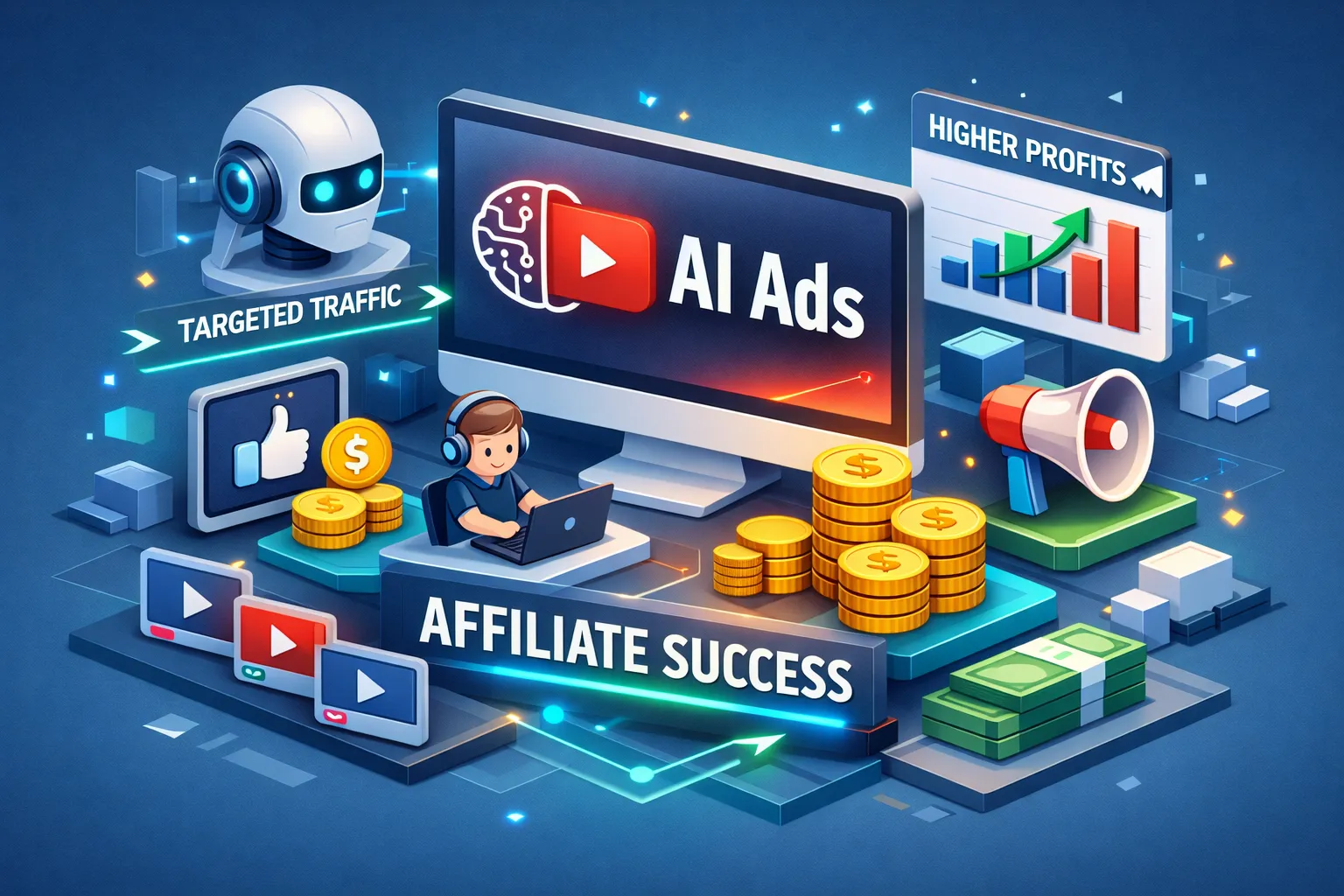
According to the IAB’s 2025 Digital Video Ad Spend and Strategy report, 22% of all digital video ad creative was built or enhanced using generative AI in 2024. By 2026, that number is projected to reach 39, 40%. AI YouTube ads aren’t a future trend, they’re already a significant and growing portion of what’s running on the platform right now. Small and mid-sized advertisers are leading adoption, with 45% of their video ads expected to incorporate generative AI by 2026, outpacing larger brands.
For affiliate marketers, YouTube is one of the more promising paid channels available, but only when approached with a clear strategy. Common failure points include choosing the wrong tool, targeting too broadly, and publishing AI-generated creative that viewers distrust on sight. The most effective affiliate campaigns combine focused strategy with AI-powered tools to generate measurable, repeatable results. That combination is what this article covers.
You’ll walk away from this knowing how AI video ads are being created, what the real risks are, which tools to use, how to target the right viewers, and what metrics to watch so you’re spending money on what works.
Why AI YouTube ads are growing this fast
The IAB’s 2025 Digital Video Ad Spend and Strategy report puts the numbers in plain terms: 22% of video ad creative used generative AI in 2024, and adoption is nearly doubling to 39, 40% by 2026. Half of advertisers were already using AI tools for video ad production by mid-2025, and 86% are either using it or actively planning to. That’s the current state of the market, not a trend on the horizon.
The more telling data point is who’s leading the charge. Small and mid-sized advertisers are expected to have 45% of their video ads incorporate generative AI by 2026, outpacing larger brands. The reason is straightforward: AI dramatically reduces production barriers. No video crew. No studio. No six-figure creative budget. For an affiliate marketer promoting a single offer to a defined audience, this changes the economics of YouTube advertising in a fundamental way. What used to cost thousands of dollars and weeks of production time now takes an afternoon and a subscription. That’s the opening AI YouTube creatives have created for independent advertisers. For additional reporting on the projected share of generative AI in video ads, see the eMarketer coverage forecasting nearly 40% adoption by 2026.
The risks you can’t ignore before you spend a dollar
Running AI-generated YouTube ads without understanding the risk landscape is how affiliates blow their ad accounts and their reputation at the same time. Google’s labeling rules, viewer psychology, and brand safety all require serious attention before you publish anything.
Google’s AI labeling rules and what they mean for affiliates
As of March 5, 2026, Google Ads requires a visible “AI Generated” label on any ad where AI-generated images, synthetic voices, or AI-written text serve as primary creative elements. The label must appear clearly within the ad unit itself, not buried in a description or footnote. Violations result in immediate disapprovals with no warning period, and repeated violations escalate to account suspension.
Google runs its own AI detection tools across creatives, so compliance isn’t optional. For affiliate marketers, every AI-generated YouTube ad needs a compliant disclosure built in before it goes live. Deepfake-style content depicting real, identifiable people is fully prohibited across all formats, YouTube, Search, Display, and Performance Max, under the same policy update.
Why viewers are more skeptical than you think
The data on viewer sentiment is worth reading carefully. NIQ neuroscience research found that even high-quality AI-generated ads produced weaker memory activation compared to traditional ads, making them less likely to drive action. A study from the NIM Marketing Intelligence Review confirmed that labeling an ad as AI-generated causes consumers to evaluate it more critically, perceiving it as less natural and less useful, even when the content is identical to a human-made version. Kantar’s 2024 Media Reactions research documented the “uncanny valley” effect specifically in AI video ads featuring rendered people, noting that AI visuals can trigger jarring reactions that register as positive on biometric monitoring but are actually just responses to something feeling off.
None of this means AI-driven ad optimization doesn’t work. It means the bar for creative quality and authenticity is higher than most affiliates assume. A mediocre AI ad isn’t neutral. It actively erodes trust.
Brand-safety incidents that should inform your approach
The documented case studies are instructive. Coca-Cola’s AI-assisted holiday campaign drew significant backlash for feeling inauthentic. Valentino’s AI-generated visuals were criticized as misaligned with the brand’s craftsmanship identity. In the programmatic video advertising space, major brands have had ads placed on AI-generated “news” sites designed to siphon ad spend, associating those brands with misinformation and eroding campaign trust. The root causes across these incidents point to the same problems: insufficient human review, overreliance on automation, and synthetic ads that prioritized speed over authenticity. A clear production and compliance process prevents all three.
Building your AI YouTube ad around one affiliate offer
Focusing each ad on a single offer is one of the most consistently recommended best practices in affiliate video advertising, supported by conversion research showing that message clarity drives higher click-through and completion rates. One product, one audience, one message, anything beyond that competes with itself and drives up your cost per acquisition.
Choosing an AI ad creation tool that fits your workflow
Four tools currently lead the space for end-to-end YouTube AI creatives: Creatify AI, Nextify AI, Pictory, and MakeUGC.ai. Each has a distinct workflow, and matching the tool to your content format matters.
- Nextify AI generates a complete ad, including script, AI video, voiceover, and thumbnail, in roughly three minutes from a product description. It uses the Sora 2 model for cinematic output quality and offers free credits with no credit card required, making it the lowest-friction starting point for beginners exploring AI ad generators for the first time.
- Creatify AI pulls directly from a product URL to generate multiple conversion-focused script variations, prioritizing speed and volume for creative testing. It suits affiliates who want to run several angles simultaneously and identify winners quickly.
- Pictory works best when you already have a script and want polished visuals and realistic AI voices layered over it. It’s the right choice when your written hook is strong and you need production quality around it.
- MakeUGC.ai excels at avatar-based talking-head formats across 29 languages, making it particularly useful for affiliate offers targeting international audiences or verticals where a direct-to-camera style outperforms standard video ads.
Match the tool to your format before committing. Using a batch-variation tool when you only need one polished creative wastes time and credits. For a deeper dive into personalization and production considerations for AI video ads, see the MIT IDE piece on personalized AI video ads.
Writing a script that sells one thing
The biggest mistake in affiliate video ads is trying to communicate too much. Your script has one job: move a specific viewer toward a single action. The structure that works is simple and repeatable, hook the viewer in the first three seconds, name the problem they’re experiencing, present your offer as the solution, and close with a direct call to action. No detours. No second offers. No hedging.
This is the same single-offer logic built into InternetMoneyPro’s training system, and it applies directly to YouTube ad scripts. A focused message converts more effectively and sharpens your targeting from the first line, because you know exactly who you’re talking to before you write a single word.
Ready to put this into practice? InternetMoneyPro’s step-by-step system connects offer selection, AI ad creation, and campaign setup into one guided process. See how it works.
Targeting the right viewers without burning your budget
YouTube’s targeting options are more powerful than most affiliates use them. The platform gives you access to custom intent audiences, in-market audiences, and placement targeting. For a single-offer affiliate campaign, understanding where each fits saves significant spend.
Audience signals that work for affiliate offers
Custom intent audiences target people who have searched for specific terms on Google, which means you’re reaching viewers at the point of active research rather than passive browsing. Build your custom intent audience around the problem your offer solves, not the product name itself. Someone searching “how to stop waking up tired” is a better target for a sleep supplement affiliate offer than someone broadly categorized as “interested in health.” For practical guidance on building custom intent audiences, see this overview of custom intent audiences.
In-market audiences capture people actively researching a category, useful for broader awareness plays. Placement targeting, where you specify particular YouTube channels or videos, works well when you know exactly where your ideal buyer spends time. For conversion-focused campaigns, custom intent audiences built around problem-specific search terms are the most reliable starting point for AI-driven ad optimization.
Setting up a campaign that doesn’t overspend early
Start with a tightly defined audience and a modest daily budget, practitioners commonly recommend starting in the $10, $20 range while you gather early data. Run two or three ad variants against the same audience to identify which creative angle delivers the lowest cost-per-view and highest click-through rate. Don’t scale anything until one variant is clearly winning. The goal in your first week is data, not volume. Scaling a losing ad faster just accelerates the waste.
How InternetMoneyPro’s AI integration streamlines campaign deployment
Where most affiliate YouTube campaigns break down
Most affiliates can follow a tutorial. The breakdown happens at the point of connecting everything: the offer selection, the audience research, the ad creative, and the campaign setup. Without a unified process, you end up with a stack of disconnected tools, a campaign that launches but never gets properly optimized, and a budget that evaporates while you figure out what went wrong. That gap between understanding the theory and running a live, converting campaign is where most of the money gets lost.
What InternetMoneyPro’s system does differently
InternetMoneyPro integrates AI tools directly into a step-by-step affiliate marketing system structured around promoting one offer to one clearly defined audience. The platform’s YouTube AI integration handles the connective tissue that affiliates typically have to assemble manually: audience analysis, ad draft generation, and campaign deployment workflow. It also includes a diagnostic framework for identifying and fixing the specific components of a campaign that aren’t converting, rather than guessing at what’s broken. The goal is to take you from setup to live campaign without the usual gap between learning and executing. If you’d like the real fix for common affiliate breakdowns, see Why Affiliate Marketing Isn’t Working for You (And the Real Fix).
Monitoring what matters and cutting what doesn’t
Once your campaign is live, four numbers give you the clearest picture: view rate, click-through rate, cost-per-click, and landing page conversion rate. A healthy view rate for a skippable in-stream ad sits above 25, 30%, with industry benchmarks ranging from 29, 66% depending on creative quality. A solid CTR benchmark is above 0.5%, with strong campaigns pushing toward 1, 2%. For additional context on video marketing benchmarks, consult aggregated video marketing statistics.
Read the metrics as a diagnostic, not just a scorecard. If your CTR is strong but conversions are low, the problem is your landing page, not your ad. If your view rate is low, the first five seconds of your creative aren’t earning the skip. If both metrics are underperforming, the audience targeting needs to be tightened. Each metric points to a specific fix.
When to scale and when to stop
Many practitioners use a view rate above 30% and a CTR above 1%, after 500 or more impressions, as the threshold to consider a 50% budget increase, followed by 48 hours of monitoring to confirm the numbers hold. If a variant is underperforming on both metrics after 300 impressions, pause it. Don’t leave losing ads running on the assumption they’ll warm up. The data you gather in the first week is more valuable than any single impression, so treat early campaign spending as research, not promotion. (These thresholds reflect common practitioner guidance; your specific benchmarks may vary by vertical and offer type.)
The simple version of a complex-looking channel
AI YouTube ads work when the strategy behind them is simple: one offer, one audience, one clear message. The technology to create and deploy these ads is more accessible than it’s ever been, but the tools don’t replace the need for a clear system. The affiliates getting results on YouTube right now aren’t running complex multi-offer campaigns with elaborate funnels. They’re running focused ones, built on single-offer principles that have consistently driven affiliate conversions across channels.
The risks are real and worth respecting. Google’s labeling rules are actively enforced, viewer skepticism is documented in neuroscience research, and brand-safety failures have real consequences. None of those risks are unavoidable if you go in informed and treat compliance and creative quality as non-negotiables from the start.
If you want a system that ties together the AI tools, the single-offer approach, and the campaign structure covered in this article, InternetMoneyPro connects every component, from offer selection to campaign deployment, into one guided process. No tutorial-stitching. No guesswork. Just a clear path from setup to a live campaign that you can actually measure. Start here.
Leave a Reply