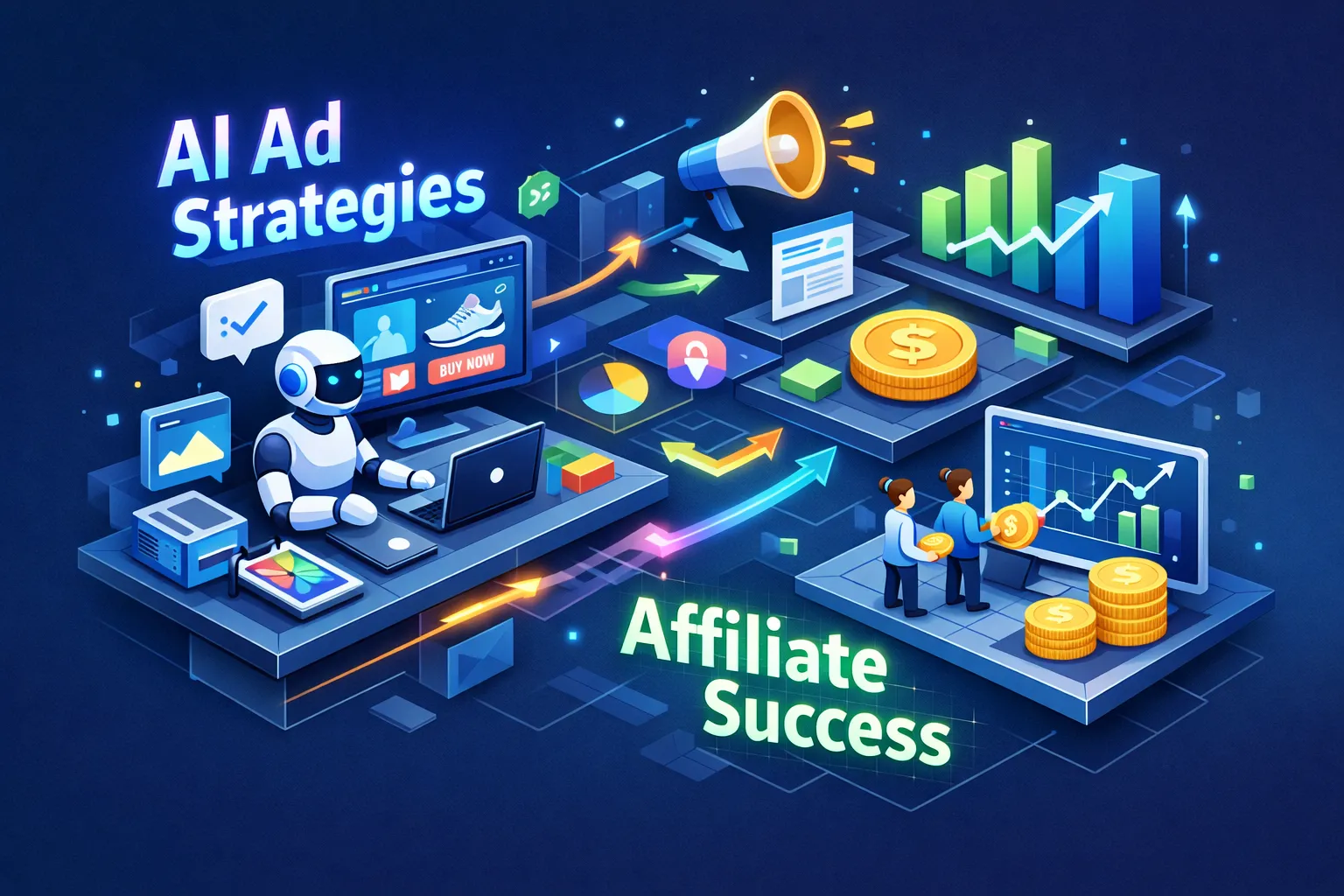
Generative AI advertising is already reshaping how serious affiliates build and run paid campaigns, and most marketers are still treating it like a novelty. A shortcut for writing punchy headlines or making a banner ad look decent without hiring a designer. That’s a mistake, and a costly one. Headway, an edtech startup, ran AI-generated video ads through Midjourney and HeyGen and pulled a 40% ROI increase alongside 3.3 billion impressions in the first half of 2024. Monks used Google Gemini to build personalized campaigns for Hatch and landed an 80% improvement in click-through rate, a 31% reduction in cost-per-purchase, and a 97% cut in production costs. These aren’t proof-of-concept experiments. These are production results from real campaigns running on real budgets.
The playbook for generative AI advertising already exists. Affiliates who learn it now, run structured pilots, and build it into their workflow will have a compounding structural advantage as the technology matures through 2026. At InternetMoneyPro, we’re building ahead of this curve, designing training systems specifically for affiliate operators who want to use AI creative without needing a media agency behind them.
Why AI-generated ads are already outperforming traditional creative
The numbers that ended the debate
Dynamic Creative Optimization (DCO) campaigns using AI deliver a 32% higher click-through rate and a 56% lower cost per click compared to static creative. AI-influenced conversions run 3 to 16% above baseline depending on the campaign. Advertisers using AI-based contextual targeting see up to 2x higher return on ad spend compared to third-party data targeting. These aren’t projections from a whitepaper. They come from documented campaign results across real platforms and real budgets.
The shift is structural, not cyclical. AI ad creative has crossed from experimental into essential. The performance gap between campaigns that use it and campaigns that don’t will keep widening as the tools improve and adoption accelerates. For a broader look at practical applications, see this roundup of use cases for generative AI in marketing.
Case studies worth learning from
Cadbury created 2,500 hyper-localized Diwali video ads featuring Shah Rukh Khan, tailored to individual local stores across India. The campaign reached 140 million people and generated a 32% engagement spike. Envidual ran an AI-optimized LinkedIn campaign that hit a 0.75% CTR, 1.7 times the industry benchmark of 0.43%. These results share a common pattern: focused creative, meaningful personalization, and AI handling a volume of output that would be impractical or cost-prohibitive for any human team to produce at scale.
The lesson isn’t to replicate these campaigns. It’s to recognize what they share: a clear audience, a single message, and AI managing execution at scale.
Generative AI advertising use cases that deliver the most return for affiliates
Ad copy and creative production at scale
The clearest immediate advantage of generative AI advertising for affiliates is volume without proportional cost. Platforms like AdCreative.ai generate conversion-focused copy, banner variants, and UGC-style video in minutes rather than days. For an affiliate promoting a single offer, that means testing dozens of creative angles, emotional, rational, social proof, without a design budget or a freelancer on retainer. The marginal cost of generating additional ad variants has dropped dramatically; producing fifty versions costs only slightly more than producing five.
This matters because creative fatigue is real. Audiences stop responding to the same ad after repeated exposure. AI gives affiliates the volume to rotate creative continuously without hitting a production bottleneck. For a compact review of breakthrough generative AI marketing use cases and how teams are applying them, this CMSWire piece is a helpful reference: breakthrough generative AI marketing use cases.
Dynamic creative optimization and personalization
DCO works by adjusting creative elements in real time based on who is seeing the ad and how previous versions have performed. The system maintains a library of modular components (headlines, images, calls to action) and assembles them dynamically for each user based on behavioral signals, demographics, and timing. Spotify uses this approach to generate individualized audio ads matched to listeners’ habits, producing higher engagement than generic spots. Read more on how generative AI and dynamic creative optimization are transforming ad creation.
For affiliates, DCO translates to higher relevance per impression without manually split-testing every combination. The system tests continuously and reallocates budget toward what’s working.
Programmatic automation and fraud detection
AI-powered programmatic buying makes ad placement more efficient by matching bids to placements in real time based on performance data. Equally important is fraud detection: AI identifies patterns consistent with click fraud and fake impressions before they drain your budget. For a solo affiliate operator working with a limited daily spend, protecting that budget from invalid traffic isn’t a nice-to-have. It’s foundational.
Tools that actually work: a practical comparison
The leading platforms and what separates them
AdCreative.ai is a strong option for high-volume generation on Meta and Google. Feed it brand assets and it produces banners, product photoshoots, UGC-style videos, and storytelling ads, with conversion score predictions attached to each output. AdStellar’s comparison of automated ad creation platforms explains how end-to-end automation differs across vendors, AdStellar itself goes further with bulk testing and competitor creative ingestion. Creatopy is built for batch creation and auto-resizing across formats, which makes it useful when you need one creative adapted across a dozen ad placements.
For video specifically, Creatify produces actor-free video ads ready for paid placements. Madgicx’s perspective on creative optimization explains why some affiliates prefer its one-click campaign launching paired with AI-generated copy and visuals. Each tool has a different strength, and the right one depends on your actual workflow, not the feature list.
How to match a tool to your actual workflow
A solo affiliate running a single offer on Meta needs ease of input, direct platform integration, and performance scoring. That points toward AdCreative.ai or Madgicx. An affiliate managing multi-platform campaigns across several products needs the bulk generation and cross-platform testing that AdStellar or Creatopy provide. Don’t pick a tool based on what it can do in theory. Pick it based on the specific bottleneck you’re trying to remove from your current process.
Running your first generative AI ad campaign: workflow and quality control
From prompt to live ad: the creation process
Start by identifying the specific task: copy, banner, or video. Then write a role-based prompt that includes context. Specify the audience segment, the offer, the desired tone, and the platform. “Write three ad headlines for a weight loss supplement targeting women over 40 on Facebook, emotional tone, focus on energy and confidence” will produce materially better output than “write some ad copy.” Prompting quality determines output quality, and vague inputs reliably produce generic ads. If you want a hands-on walkthrough for integrating AI into daily affiliate workflows, see our guide How to Use AI for Affiliate Marketing.
Generate multiple variants, then iterate through conversation rather than rebuilding from scratch. Ask the tool to make one version more urgent, another more benefit-focused, another shorter. You’ll land on a workable test set faster this way than by starting a new prompt each time.
QA, brand safety, and IP checks before publishing
This is where most people cut corners and regret it. Every AI output needs a human review before it goes live. Check for tone alignment against your offer and audience. Confirm the creative doesn’t lean on visual styles or copy that could infringe on another brand. Verify that the AI model you’re using sourced its training data legally, and review outputs specifically for originality. Generic creative that could belong to any brand erodes trust over time.
One data point worth keeping in mind: 50% of consumers say they prefer non-AI content. That doesn’t mean you avoid AI creative, it means your AI creative needs to feel specific and human, not templated. The risk isn’t that AI produces bad ads. The risk is that it produces forgettable ones.
Measuring whether it’s working: KPIs that actually matter
The metrics to track from day one
Primary KPIs for AI ad creative are CTR, engagement rate, conversion rate, and AI-influenced conversion rate. Track that last one by using UTM parameters on all AI-generated creative and running post-conversion surveys asking what led the customer to act. AI-influenced conversion rates run 3 to 16% above baseline in documented campaigns, but you won’t see that in your own data if you’re not tracking it cleanly. Secondary metrics worth watching include cost-per-purchase, campaign reach, and time-to-production.
Time-to-production is easy to overlook, but it compounds. If generative AI advertising tools reduce your creative production from three days to three hours, that efficiency multiplies across the full campaign lifetime. You can test more, iterate faster, and respond to performance data in near real-time instead of waiting for a new batch of creative.
A/B test design that gives you real answers
Run clean experiments: AI-generated variant against a human-created control, equal impressions and equal budget, a minimum run time of 7 to 14 days, and one variable isolated at a time. For affiliates starting with a single offer, begin with a head-to-head test comparing two copy approaches, an emotional angle versus a rational benefit-focused angle. Aim for at least 1,000 impressions per variant before drawing conclusions. Move to multivariate testing only after the head-to-head gives you a clear signal on which approach resonates. For practical tips on creative testing and A/B best practices, see resources that outline ab-testing best practices and creative testing workflows.
What 2026 looks like and what affiliates should do now
The shift from creative generation to full campaign autonomy
AI is moving from producing individual creative assets to running entire campaign cycles with minimal human input. By 2026, early indicators suggest AI agents will generate copy and visuals, select audiences, adjust bids, and reallocate budget across placements in one automated loop, though the pace of adoption will vary by platform. Google advertisers created 70 million assets through Gemini in Q4 2025 alone, three times the year-over-year volume. The tools are scaling faster than most affiliates realize, and the barrier to entry for sophisticated AI ad optimization is dropping every quarter. For additional perspectives on AI in digital marketing, this overview of AI tools in digital marketing is useful.
For large media buyers, much of this is already operational. For independent affiliates, it’s arriving fast and will be accessible through platforms that don’t require technical expertise or large budgets.
Where affiliate marketers fit and what InternetMoneyPro is building
Affiliate marketing has always rewarded people who find leverage. Generative AI advertising is the next major leverage point. The barriers that kept solo affiliates out of serious paid traffic, production costs, creative testing speed, and targeting sophistication, are collapsing simultaneously. Affiliates who build comfort with AI creative workflows now will be positioned to activate more powerful tools immediately as they become available.
InternetMoneyPro is building training and systems designed specifically for affiliates running focused, single-offer campaigns. The goal is straightforward: give solo operators access to the same synthetic media advertising and creative automation capability that performance agencies use, without the agency overhead or technical prerequisites. If you’re building your affiliate system now, getting comfortable with generative AI advertising workflows isn’t optional preparation for the future. It’s the right move for today. Learn a practical daily workflow in our guide How to Use AI for Affiliate Marketing: A Real Daily Workflow.
Start with one use case and build from there
The affiliates who will widen the gap in 2026 are not the ones with the biggest budgets or the most sophisticated tools. They’re the ones who run structured pilots now, measure results honestly, and refine their workflow systematically. Generative AI advertising is not a future consideration. The performance data already exists. The case studies already document what works. The tools are already accessible at price points a solo operator can afford. For ongoing updates and deeper posts, check out The Blog.
Pick one use case: ad copy generation, DCO on an existing campaign, or a head-to-head A/B test against your current best-performing creative. Run it cleanly, measure the right KPIs, and let the data tell you where to go next. That’s the playbook for generative AI advertising in 2026. It’s not complicated, but it requires actually starting. If you want a blueprint for structuring an affiliate setup around these workflows, read about what an affiliate marketing system that works actually looks like and use that as your implementation checklist.
Leave a Reply