
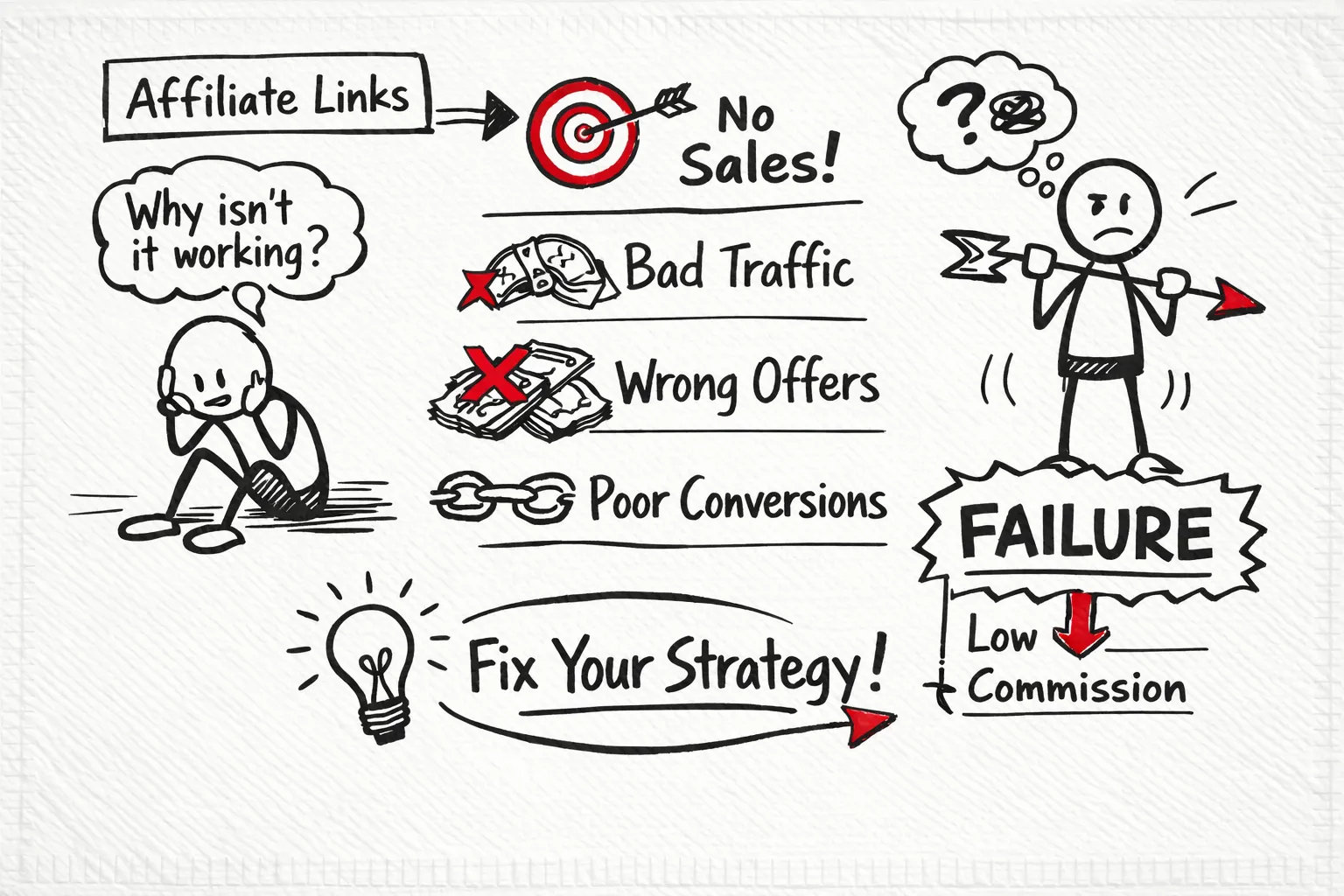
Most affiliates running what they call an affiliate marketing strategy don’t actually have one. They have a collection of tactics picked up from YouTube videos, blog posts, and forum threads, stacked on top of each other with no real structure underneath. Many lack any documented plan at all, and the pattern shows up in the results: inconsistent commissions, weeks of work with nothing to show, and eventually quitting while convinced the whole model is broken.
It’s not broken. The structure is missing.
This article isn’t another tactics list. It’s a diagnostic. By the end, you’ll know exactly what’s broken in your current affiliate marketing strategy, how to audit it properly, and how to build a focused plan that actually produces results. The diagnostic framework here comes from the system built inside InternetMoneyPro, designed specifically to find the first broken link in an affiliate setup before adding more volume to a leaking bucket.
The real reason affiliate marketing strategies fail
There’s no shortage of affiliate marketing tactics, only structure
Most affiliates consume advice endlessly. They read everything, bookmark everything, and test a little of everything. They add tactics the way people add apps to a phone: constantly, without ever removing what isn’t working. The result is chaos with a content calendar. Affiliate marketing tactics without a system are just experiments with no feedback loop. You don’t learn from them because you can’t isolate what changed.
Promoting too many things to too many people
Affiliates who focus on a single offer to a defined audience consistently outperform those juggling multiple programs across multiple niches. The Revo case study makes this concrete: a focused affiliate program strategy produced a +56% increase in revenue and a 65% improvement in average order value. Affiliates who scatter their attention across five programs and three niches rarely generate enough data from any single offer to know whether it’s working. They’re always guessing.
The feedback loop that never gets built
Without tracking and attribution configured before the first piece of content goes live, there’s no way to know what’s driving results. Most beginners run campaigns for weeks before realizing they have no measurable data. That’s not a traffic problem. That’s a structural problem, and adding more content on top of it just makes the confusion worse.
Five warning signs your affiliate marketing strategy is broken
Your conversion rate sits below 1% month after month
Industry benchmarks generally show affiliate conversion rates running between 1-3% across most niches, with high-intent sectors like finance and SaaS reaching 4-8% (per 2026 affiliate benchmark reports). If you’re consistently below 1%, start by investigating upstream factors: audience match, content format, and offer fit, though product quality should be ruled out too. An EPC below $0.15 is another red flag tied to the same root issue. Strong programs push EPC to $1.50 or higher. If yours doesn’t, that gap needs explaining before you scale anything. Affiliate conversion optimization starts with diagnosing these numbers, not adding more traffic on top of them.
You’re running multiple offers with no clear winner
Scattered affiliate monetization strategies split your audience’s attention, and yours. When no single offer gets enough traffic to generate useful data, you’re always guessing. You can’t optimize what you can’t read. Focus isn’t a nice-to-have. It’s what makes the numbers readable and the decisions defensible.
You can’t trace a commission back to a specific piece of content
If you don’t know which post, email, or video drove a sale, you can’t replicate it. That’s the definition of a promotion plan with no feedback loop. Every content decision becomes a gut call, which compounds the problem month after month of effort going into a black box.
How to audit your affiliate marketing strategy and find the gaps
What a real affiliate strategy audit looks at
A proper audit examines four components, and most self-audits skip three of them. The first is audience clarity: are you talking to one specific person with one specific problem? The second is offer alignment: does the product actually solve that problem convincingly? The third is content performance: which formats and topics are driving clicks and conversions? The fourth is tracking integrity: can you attribute results reliably back to individual content pieces? Most self-audits people run are just traffic reviews. That’s looking at the scoreboard without watching the game. Traffic is a symptom. These four components tell you the cause.
Where InternetMoneyPro’s diagnostic framework changes things
The system inside InternetMoneyPro was built to run exactly this kind of audit: starting with the audience, isolating the offer, and identifying the first broken link in the chain. It doesn’t assume the problem is more traffic. It asks whether the foundation is solid before adding volume on top of it. For affiliates stuck at zero commissions or inconsistent results, this is often the first time they’ve looked at their setup as a system rather than a series of individual moves. That shift is usually where the numbers stop being random.
The gaps most self-audits miss
Two components almost always get skipped. The first is commission model fit: is flat-rate or percentage commission better suited to your niche’s typical order value? The second is content-format mismatch. Industry data suggests email consistently outperforms most formats at roughly a 5.3% conversion rate compared to approximately 2.3% for product reviews, though your specific niche and audience behavior should guide which benchmark you apply. Picking the wrong format for the right audience is a slow leak that’s easy to miss until you audit it deliberately.
Choosing the 3-5 partner marketing tactics that fit your niche
Matching tactics to niche behavior and traffic type
Finance and SaaS niches convert well through long-form comparison posts and email funnels. Visual niches like beauty and tech favor video content, studies on content format performance suggest video can deliver significant lift over text-only formats in these categories, though the exact range varies by niche and execution. The most common mistake is copying partner marketing tactics from a success story in a completely different niche and expecting the same results. Start with where your audience makes decisions. Then choose the format that meets them there. That sequencing matters more than which tactic sounds impressive.
The 90-day constraint is your best filter
If you can’t execute a tactic consistently for 90 days with your current resources, it doesn’t belong in your affiliate marketing strategy. Narrow the list to 3-5 moves you can actually maintain. The HealthyLife case study demonstrated what focus produces: by concentrating on high-performing lower-funnel partners, specifically cashback, loyalty, and coupon sites with dynamic reward structures, they achieved a 14%+ affiliate conversion rate and a +32% revenue lift during peak periods. Not because they did more. Because they focused hard on fewer things and executed those things well.
Building your 90-day affiliate execution plan
What each 30-day block should accomplish
Days 1-30 are foundation work: one offer, one audience definition, tracking configured before a single piece of content goes live. Days 31-60 are about content execution with at least one email channel activated, this is when the data starts speaking, and you need to be ready to listen. Days 61-90 are for reviewing what’s converting, cutting what isn’t, and increasing distribution on what is.
The Bombas case study illustrates this kind of disciplined sequencing: by moving away from coupon-heavy tactics toward full-funnel content affiliates, they grew affiliate revenue’s share of total revenue from 0.5% to 9%. That didn’t happen because they worked harder. It happened because they worked in the right order.
The one rule that keeps the plan from collapsing
Don’t add a new channel or tactic until you have a measurable result from the current one. Adding complexity before clarity is what turns a strategy back into a random pile of activities. One focused, tracked, iterated loop beats five simultaneous experiments every time. The plan only works if you protect it from your own impulse to do more.
Tracking, attribution, and the KPIs that tell you the truth
First-click vs. last-click vs. multi-touch: which one to use
Last-click attribution is the default for most affiliate platforms and the least accurate picture of what’s actually driving conversions. It gives all the credit to the final touchpoint and ignores everything that built the decision before it. Multi-touch attribution, available through tools like Everflow and RedTrack, shows every touchpoint in the journey, and that matters especially in longer decision cycles like software or finance purchases. For beginners running simple setups, last-click is fine to start. But it should graduate to multi-touch as volume and complexity grow.
The three KPIs worth tracking from day one
Conversion rate is the first: target 1-3% to start and benchmark it against your specific niche. EPC is the second: below $0.15 is a red flag, while $1.50 and above indicates strong program-audience fit. Active content contribution is the third: which specific pieces are generating clicks and attributable sales. Everything else is vanity data unless these three are dialed in and reviewed weekly.
Tools that are worth the cost
Everflow fits larger operations at around $750/month with fingerprint and cookieless tracking built in. RedTrack suits media buyers scaling paid campaigns, with Conversion API support for Meta and AI-driven automation. For beginners, LeadDyno at around $49/month provides enough structure to start tracking meaningfully without the overhead. Note that pricing and features change, verify current plans directly with each provider. The tool matters less than the discipline of checking the data weekly and making one change at a time based on what it shows. Switching tools doesn’t fix a broken habit of ignoring the numbers.
The fix starts with an honest look at what you already have
Affiliate commissions don’t stay inconsistent because people lack tactics. They stay inconsistent because there’s no system connecting audience, offer, content, and tracking into one readable loop. A sound affiliate marketing strategy isn’t built from more activity, it’s built from knowing where the first thing broke and fixing that before anything else. When something breaks, you need to know where. That requires a diagnostic lens before anything else, not more content, not a new program.
Before you publish another post or test another offer, audit what you already have. Run the framework outlined in this article. Or use the diagnostic system inside InternetMoneyPro to identify the first broken link in your setup and fix that one thing before building further. The system is structured specifically for this: starting with clarity, not volume.
Consistent commissions aren’t the result of doing more. They’re the result of doing fewer things correctly, repeatedly. That’s how systems work.
Leave a Reply